
In recent years observations in active galaxies revealed highly ionized relativistic winds [1] and kiloparsec-scale outflows [2] which are evidence for galaxy-wide outflows induced by active galactic nuclei (AGN).
According to the model of AGN wind feedback [3] if the mass of the supermassive black hole (SMBH) exceeds some, particular for a galaxy, critical mass then its wind shocks can propagate to large distances from SMBH where it is not efficiently cooled by Compton scattering any more and then hot (~107 K) and fast (~103 km/s) energy-drivenoutflows form. These violent outflows can blow gas and dust away from a galaxy and therefore stop the star formation in it. However, since after the shock and cooling the matter density in an outflow can be about million times higher than the pre-shock density, these outflows could also induce gravitational fragmentation of gas and star formation similarly like expanding shells of supernovae do, but on larger scale.
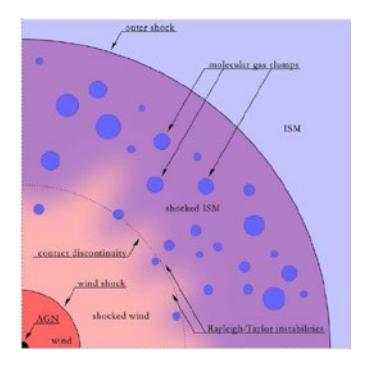
This work is concerned with determination of the statistical distribution of masses of gas clouds that should form in the outflow, the star formation rate in these clouds when they gravitationally collapse and observational properties of these processes. To achieve this the ideas of the analytical models of turbulent gas fragmentation, collapse and star formation derived for more standard star formation regions are used (e.g. [5,6]) with some refinements which are required in the more extreme environment that is studied. The resulting properties differ from those in standard environments. For example, the mass function of gas clouds is found to be flatter, that is, a bigger fraction of clouds that form are massive.