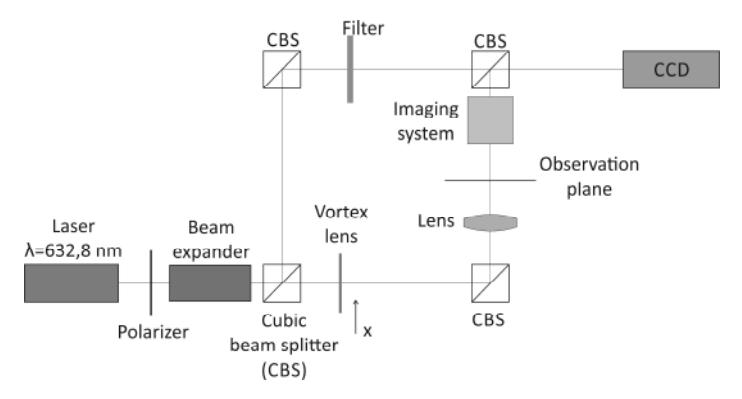
Optical vortex scanning microscope (OVSM) uses focused beam, carrying the optical vortex, to scan the sample. Optical vortex is stable phase dislocation [1]. We present the new setup of the OVSM (Fig. 1), which is based on the carrier frequency interferometry. In OVSM system optical vortex is generated by vortex lens, also known as spiral phase plate. Optical vortex moves inside the beam, due to vortex lens shift (shift in the x direction, perpendicular to the axis of the beam propagation) [2, 3].
The line along the vortex move, inside the beam, is called a vortex trajectory. The range of the vortex shift measured at the sample plane is reduced few hundred times, comparing to the vortex lens shift [3]. When there is no object at the sample plane, the vortex point moves along the straight line. The inclination of this trajectory depends on the observation plane position. The position of the observation plane, where the optical vortex trajectory is perpendicular to the vortex lens shift is called a critical plane [4]. At critical plane optical vortex has the highest sensitivity to small phase variations. This opens new possibilities to sample scanning.
The phase retrieval algorithm of object beam (based on the Fourier transform method) and new experimental results will be presented. We tested new design of the OVSM by measuring objects with different topography, such as: optical wedge, groove and diffraction grating.