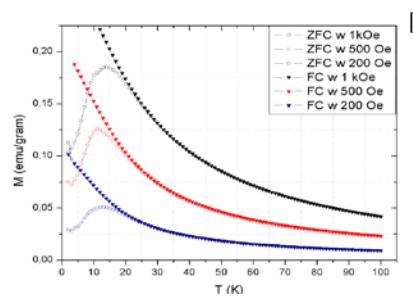
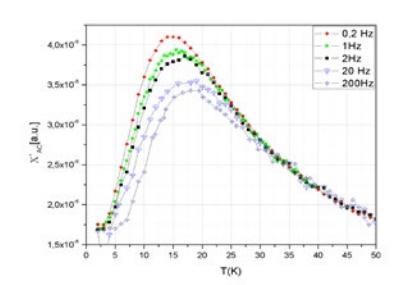
The aim of presentation is to show selected magnetic properties of nanoparticles and to demostrate results of some measuments, which were taken in Department of Magnetic Research in Institute of Nuclear Physics Polish Academy of Science. The measurements were performed for horse-spleen ferritin (HoSF) by using MSMP SQUID magnetometer.
HoSF is protein with very interesting properties such as superparamagnetism [1], so since '40 it is subject of many scientific research in fields like nanotechnology, molecular biology or chemistry. It is responsible for storage and transportation of iron in body. Besides small particles are more economical: they need less energy to overcome the crystal-field anisotropy and lower thermal energy to reverse spin [2].
Due to its two-phase iron core (highly crystalline core and disordered surface layer), it produces spin frustration, which destabilizes simple collinear model of Stoner-Wohlfarth [3]. In consequence nanoparticles (ferritin also) exhibit lack of saturation. The hysteresis loops are very narrow and usually above 3 T become closed.
Interest in magnetic properties of ferritin is connected with possibility to use it in resonsans tunelling.
The presentation will show results of AC and DC susceptibility as well as output of Dynamic Light Scattering, which determine the size of particles, because for nanoparticles properties change depending on their size.
That data allows to state such values as spin relaxation time or blocking temperature in which magnetization vector is blocked in energy minimum [2].