
Stable isotope ratio mass spectrometry method is widely used in ecology, geology, environmental and other studies [1, 2]. This method was applied to investigate stable carbon isotope ratios in fossil fuels. Samples were taken in various gas stations in Vilnius, Lithuania. The sampling was performed in fall of 2014 while analyses were made during the winter of 2015. The samples were stored in gas tide vials until analysis.
The main aim of this work was to determine differences in stable carbon isotope ratios of gasoline and diesel fuels from fuel providers available in Vilnius city (Lithuania).
28 samples (15 petrol and 13 diesel fuel) were collected from 14 different fuel stations. Stable carbon isotope ratio ($\delta^{13}C_{TC}$) was measured using EA-IRMS system (Elemental Analyser Thermo Flash EA1112 connected to Isotope Ratio Mass Spectrometer Thermo Delta V Advantagevia ConFlo III interface). The analysis of $\delta^{13}C_{TC}$ values revealed that diesel $\delta^{13}C$ values varied in the range from -30.71 ‰ to -30.90 ‰ with an average value of -30.76 ‰. Meanwhile gasoline had an average value of -29.96 ‰, where the $\delta^{13}C$ values were in the range from -29.57 ‰ to -30.13 ‰.
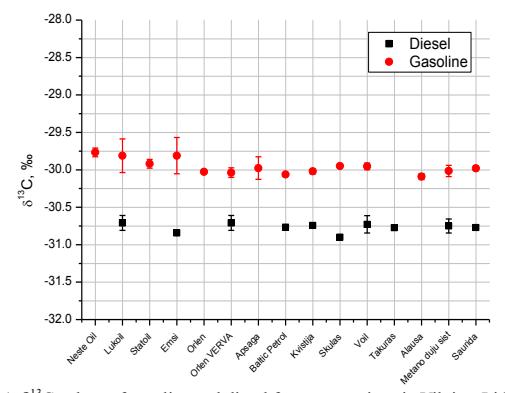
Carbon isotope ratio of diesel and gasoline differ by ~0.8 % according to our analysis. The main cause for the difference in $\delta^{13}C$ values in diesel and gasoline could lie in the different petroleum treatment processes.
The results of stable carbon isotope analysis were used to calculate the average isotopic ratio value of crude oil based fuels and it can be useful to compare this ratio with the $\delta^{13}C$ values of other aerosol sources (biomass burning, grass burning, coal burning, etc.).