
Lasers based on quantum dots (QDs) have many advantages such as low threshold current, wide spectral tunability and high temperature insensitivity. However, due to low carrier density inside the dot, the efficency of quantum dot lasers is reduced. One of the proposed solutions is a quantum well-quantum dot tunnel injection structure. The density of states in a quantum well (QW) is high, hence a QW can be used as a carrier-collecting reservoir [1,2]. The QW-QD system must be properly designed to ensure localization of its ground state in the dot. Then, with phonon-assisted processes, carriers can tunnel through the barrier from the QW to the QD.
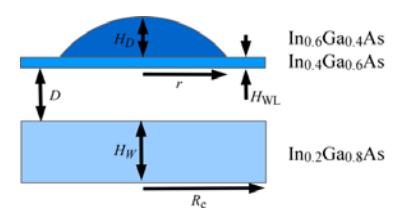
In this contribution, we study phonon-assisted tunneling of electrons in a system composed of a dome-shaped QD placed above a QW (Fig.1). We assume the axial symmetry of the system which allows us to reduce the problem to two dimensions [3].
The strain distribution is accounted by minimization of the elastic energy of the system [4]. The electron states are calculated using $\mathbf{k} \cdot \mathbf{p}$ method combined with the Lödwin elimination [5]. It turns out that carriers in the QW effectively feel strain as a repulsive potential, which affects their wavefunctions.
We study the effects of the electron coupling to the acoustic phonons and model the electron kinetics within the correlation expansion approach. We investigate the dependence of the phonon-assisted tunneling rate on the temperature. Our results indicate the importance of a proper design of the system geometry and composition to obtain the shortest relaxation times.