It is well known that in order to represent the bound state of the system formed of identical particles, including the nuclei of atom, the use of binary cluster model depends heavily on 9-j symbol [1] and harmonic oscillator transformation coefficients (3HOB) [2]. In particular for creating the desirable wave-function the use of angular momenta algebra which in order to couple four angular momentum vectors relies heavily on re-coupling coefficients, which are directly related to purely mathematical 9j symbol. 9j symbol is also very widely used in atomic and molecular calculations. In these calculations, depending on the system which is researched, the number of evaluations can construct the main portion of the whole algorithm, thus effectively requiring large computing resources.
In order to construct wave function to describe the bound state of the system consisting of identical fermions must obey the principle of Pauli. Also, not taking into account other significant properties of this type of wave function, it has to be strictly translational invariant. It can be achieved by using translational invariant wave-function expansion which splits the components into symmetric and antisymmetric according to permutations in separate subsystems. This type of wave-function will be dependant only from intrinsic (Jacobi) coordinates which describe only system local degrees of freedom, thus making the wave-function of system independent from the freely moving centre of mass coordinate. This type of transformation requires the use of Talmi-Moshinsky transformation and corresponding brackets. In general these transformations describe an explicit transformation from one set of Jacobi coordinates to another upon passing to different coupling schemes.
This type of approach creates high interest in the accurate and fast calculation routines. Moreover, use of faster algorithms for evaluation of aforementioned transformation coefficients often result in loss of precision which could limit the scope of created algorithm and create uncertainties in results. Therefore, it is essential to have efficient methods for fast evaluation of given coefficients. Moreover, evaluation of given kind are often repetitive, requiring the values, which were already used. Therefore, on purpose to reduce the effective calculation to the maximum, one by can store the evaluated coefficients in the memory of computer. However, by increasing the maximum value of angular momenta for 9-j symbol and energy quanta for 3HOB, it can be observed that the number of calculated coefficients is rising very rapidly, as a result making the the storage and retrieval of needed values a moot point.
One of obvious solutions to employ the symmetries of 9-j symbol and 3HOB, thus effectively reducing the amount of values which require storage. Although use of all symmetry properties of 9-j symbol is quite complex and require large amount of binary calculations, by using only selective symmetry properties one can significantly speed up the process of acquiring required values. Also this type of approach allows use of complex and slow, but very accurate calculation methods for initial coefficient evaluation, thus extending the range of stability of whole algorithm and providing with more accurate results.
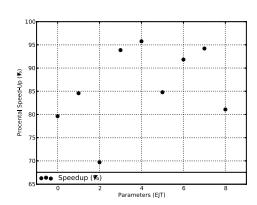
In presentation we address the problem for fast Harmonic oscillator transformation brackets for Talmi-Moshinsky transformation and 9-j symbol evaluation requirements. Our approach lets us considerably reduce calculation time of nuclear calculations (Fig.1).