Hyperbolic metamaterials (HMMs) represent the ultra-anisotropic limit of traditional uniaxial crystals, and one of the principal components of either their permittivity $\mathbf{\epsilon} = diag[\epsilon_o,\epsilon_o,\epsilon_e]$ or permeability tensors $\mathbf{\mu} = diag[\mu_o,\mu_o,\mu_e]$ is opposite in sign to the others. Here, the subscripts o and e indicate components parallel and perpendicular to the anisotropy axis, respectively. Nowadays, there are two types of HMM: Type 1 with Re($\epsilon_o$) > 0, Re($\epsilon_e$) < 0 and Type 2 with Re($\epsilon_o$) < 0, Re($\epsilon_e$) > 0. Unique properties of HMMs stem from the hyperbolic form of their isofrequency surface for extraordinary wave [1]. In this study we deal with electric hyperbolic structures, i.e. with $\mu_o = \mu_e = 1$.
We propose the concept of generalized hyperbolic metamaterials (GHMMs) which high-wavevector isofrequency surface has more complex form than a hyperboloid. A layered metal-dielectric structure composed of alternating slabs of a biaxial absorbing crystal and a biaxial conducting crystal is an example of GHMM. We predict the effective medium permittivity tensor of the layered GHMMs using Maxwell-Garnett approach [1], which is valid in the long wavelength limit. We restrict ourselves on the case when the effective medium permittivity tensor is biaxial, i.e. in the system of its principal axes one takes form $\epsilon_{\rm eff} = diag[\epsilon_{xx}, \epsilon_{yy}, \epsilon_{zz}]$. It means that we deal with high symmetry crystals.
Consider the set of alternating dielectric and metallic slabs. Dielectric slab is a slab of "uniaxial" absorbing crystal of thickness da with permittivity tensor $\epsilon_a = diag[\epsilon_o, \epsilon_o, \epsilon_e]$ and metallic slab is a slab of isotropic metal of thickness dm with permittivity $\epsilon_m$. Let us work in the system of absorbing crystal's principal axes, i.e. when $\epsilon_a = diag[\epsilon_o, \epsilon_o, \epsilon_e]$ and the direction of the anisotropy axis coincides with the normal to the slabs' interface. If the absorbing crystal and the isotropic metal are chosen properly then we can "move" the negative sign along the diagonal of the effective permittivity tensor by means of the rotation of the absorbing crystal's anisotropy axis. For instance, let $\epsilon_a$ and $\epsilon_m$ be chosen properly and when $\epsilon_a = diag[\epsilon_o, \epsilon_o, \epsilon_e]$ components of the corresponding effective medium permittivity tensor are such that Re($\epsilon_{xx}$) > 0, Re($\epsilon_{yy}$) > 0 and Re($\epsilon_{zz}$) < 0. When we rotate the anisotropy axis of the absorbing crystal so that its permittivity tensor in the chosen coordinate system takes form $\epsilon_a = diag[\epsilon_o, \epsilon_e, \epsilon_o]$ then Re($\epsilon_{xx}$) > 0, Re($\epsilon_{yy}$) < 0 and Re($\epsilon_{zz}$) > 0. We have shown that there are a lot of appropriate parameters for a "uniaxial" absorbing crystal and an isotropic metal.
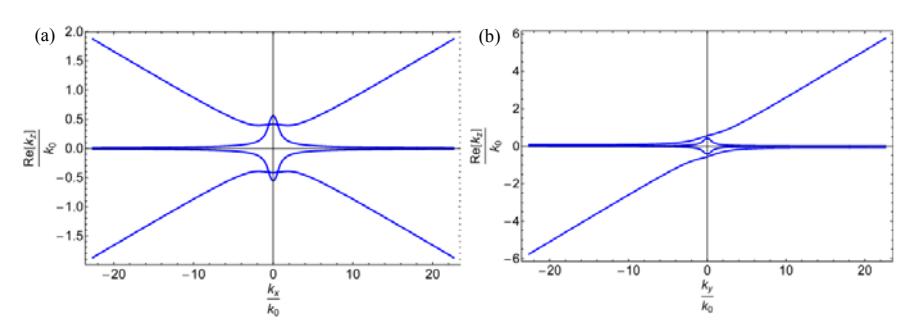
Isofrequency surfaces of an effective medium are determined by its permittivity tensor. From the above mentioned follows that we can literally choose a place of signs on the effective permittivity tensor's diagonal. This fact gives us the opportunity to obtain such isofrequency surfaces as we would get if we could rotate the anisotropy axis of HMM. Moreover, behavior of the transmission coefficient for such GHMMs is almost the same as for HMMs with "rotated" anisotropy axis. There are several interesting intermediate isofrequency surfaces, i.e. when the absorbing crystal's principal axes do not coincide with basis vectors of the above chosen coordinate system and neither $\epsilon_a$ nor $\epsilon_{\rm eff}$ takes diagonal form. Fig. 1 shows examples of obtained isofrequency curves of the effective medium which corresponds to the layered metal-dielectric structure with $\epsilon_a = diag[1.7, 1.7, 1.5+3i]$, da = 9.778nm, $\epsilon_m = -2+0.7i$ and dm = 8nm, when angle between the absorbing crystal's anisotropy axis and normal to the interface equals 0.3 rad. It is evident that axial symmetry is lost and transmission coefficient now depends both on the angle of incidence and plane of incidence.
We have shown that the effective medium indeed describes corresponding layered metal-dielectric GHMM (for propagating modes) by comparing their transmission and reflection properties.