Understanding galaxy star formation histories is crucial to constrain cosmological parameters and galaxy evolution scenarios in general. Here we present a method developed to recover star formation histories based on simple stellar population approach applied for the interpretation of stellar photometric data of the resolved galaxies.
Photometric measurements of a star sample in a galaxy are compared to a theoretical model bank of simple stellar populations to derive age and mass probability density distribution functions of individual stars. Assuming that the star sample consists of star subsamples of various ages, the total mass of stars born at particular time in the past (i.e. star formation history) is recovered.
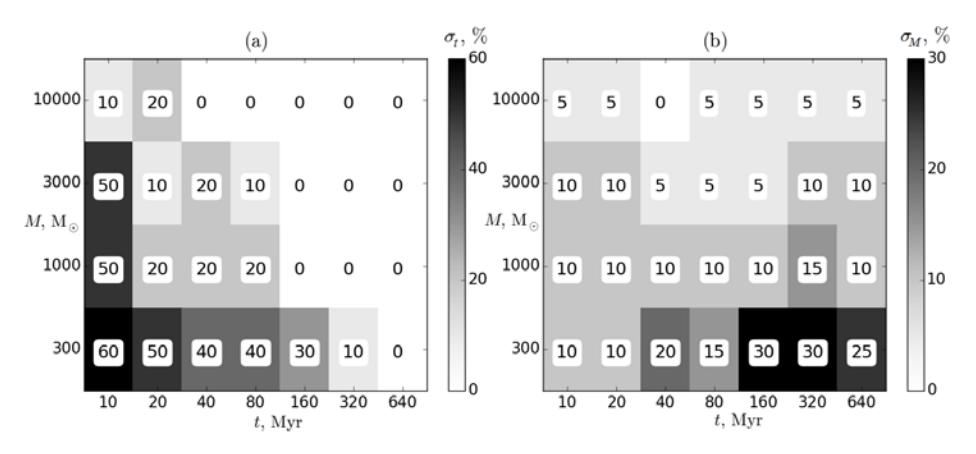
Performance of the method was tested on simulated observations of simple stellar populations (7 age and 4 mass nodes) of the quality that is achieved with Subaru telescope in the M33 galaxy using BVRI filter system. Padova isochrones [1] and Kroupa initial stellar mass function [2] were used to simulate 20 populations per each node. The half-width of the interval between 15th and 85th percentiles of the recovered parameter distributions divided by the true parameter (age or mass) value are displayed as accuracy in each node of Fig. 1.
The method is applicable to the ground-based wide-field survey observations of nearby resolved galaxies, like M31 and M33, and also for the Hubble Space Telescope and forthcoming James Webb Space Telescope data of a more extensive sample of distant galaxies.