
We consider ultracold atoms in a two-dimensional optical lattice of the dice geometry in a tight-binding regime. The atoms experience a laser-assisted tunneling between the nearest neighbour sites of the dice lattice accompanied by the momentum recoil. This allows one to engineer staggered synthetic magnetic fluxes over plaquettes, and thus pave a way towards a realization of topologically nontrivial band structures. In such a lattice the real-valued next-neighbour transitions are not needed to reach a topological regime. Yet, such transitions can increase a variety of the obtained topological phases. The dice lattice represents a triangular Bravais lattice with a three-site basis consisting of a hub site connected to two rim sites (See figure 1).
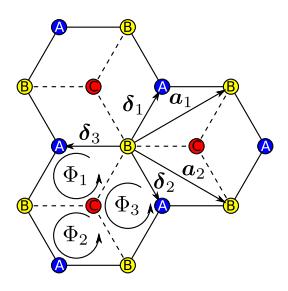
As a consequence, the dice lattice supports three dispersion bands. From this point of view, our model can be interpreted as a generalization of the paradigmatic Haldane model [1] which is reproduced if one of the two rim sub-lattices is eliminated. We demonstrate that the proposed upgrade of the Haldane model creates a significant added value, including an easy access to topological semimetal phases relying only on the nearest neighbour coupling, as well as enhanced topological band structures featuring Chern numbers higher than one leading to physics beyond the usual quantum Hall effect. The numerical investigation is supported and complemented by an analytical scheme based on the study of singularities in the Berry connection [2].