The optical investigations of zinc were started in 1950s [1] and were, in principle, directed to confirm the Drude theory – predicted IR response of simple metals. When using pseudo-potential method the band structure of the Zn have been calculated [2], was made an attempt to modeling the optical response (optical conductivity), but good agreement with experimental date was not reached. In this work we present spectroscopic ellipsometry (SE) study and analysis of interband optical transitions of monocrystalline zinc.
The main experimental problem is that a determination of both the ordinary and extraordinary components of the dielectric function tensor in uniaxial metals requires measurements from several crystallographic planes. Refractive index of zinc in the VIS spectral range is very high, and Zn is also very active for cohesion with oxygen. Due this reasons measurements of optical response of Zn is quite complicated. By a cleavage can be easily disclosed clean (001) surface, whereas preparation of the (110) surface requires more attention. We used combined preparation technology involving mechanical polishing and chemical etching, and for final step Ar+ ion etching in UHV chamber. The optical response of Zn was measured by the generalized spectroscopic ellipsometry technique [3], using two ellipsometers (both J. A. Woollam Co, Inc.), a dual rotating compensator RC2 (0.73 – 6 eV) and rotating compensator Fourier transform ellipsometer IRSE (2000 – 5000 cm-1). Ellipsometric data were recorded in the 0.25 – 6 eV spectral range, in the steps of 1 nm at various incidence $\theta$ and azimuthal $\phi$ angles in the intervals of 45 – 80° and 0 – 90°, respectively. At each incidence and azimuthal angle, the experimental ellipsometric parameters $\Psi$ and $\Delta$ were simultaneously recorded.
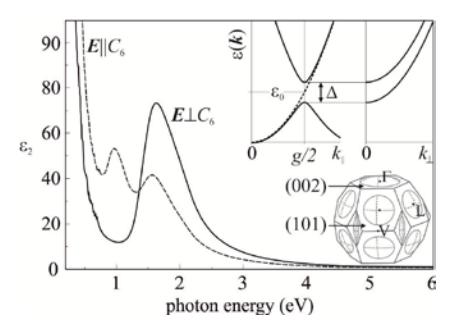
The optical response of Zn in the IR spectral range is dominated by the intraband, Drude-type, optical transitions, whereas in VIS spectral range occur the interband transitions across the pseudogaps, which open at intersections of the Fermi surface with 002 and 101 families of Bragg planes. Interband optical transitions across pseudogaps depends significantly on the polarization of the probing light beam. This can be clearly observe in $\varepsilon_2$ spectrum (Figure 1), which was deduced from analysis of SE data employing semi-infinite uniaxial substrate model. Depending on the polarization of light there are two or one absorption peaks in the $\varepsilon_2$ spectrum. For light polarization perpendicular to an optical, C6, axis, the interband optical transitions occur only across $\Delta_{101}$ pseudogaps. For light polarization parallel to an optical axis, optical transition occur both across the $\Delta_{101}$ and $\Delta_{002}$ pseudogaps. Optical response of monocrystaline zinc was described using nearly free electron approximation (NFE) and two band model (two band model of NFE spectrum presented in Fig. 1 inset). In the IR spectral range optical conductivity was described using Drude theory (two variable parameters – relaxation time and static conductivity), whereas in the VIS region by the interband optical transitions of the valence electrons (four variable parameters – $\Delta_{101}$, $\Delta_{002}$ and broadening parameters for each pseudogaps). The determined width of the pseudogaps values are $\Delta_{101}=1.55$ eV and $\Delta_{002}=0.9$ eV.
The calculation of density of the states allowed us for a determination of Fermi level ($\varepsilon_F = 9.12$ eV) and Sommerfeld parameter ($\gamma = 0.61$ mJ K-2 mol-1), which is in good agreement with the experimental values [4].