
Metal borohydrides are versatile materials. Their traditional application is as selective reducing agents in chemical synthesis (LiBH4, NaBH4). Metal borohydrides contain large amount of hydrogen relative to the other groups of inorganic compounds and as such they could be used as materials for chemical hydrogen storage [1]. In addition, they could serve as precursors towards numerous refractory metal borides and e.g. superconducting MgB2 which may be synthesised in thermal decomposition process of Mg(BH4)2 at temperatures above 350 °C [2]. Furthermore, a high lithium ion conductivity has been lately reported for LiLn(BH4)3Cl, Ln = La, Gd [3]. These features render metal borohydrides as valuable and comprehensive group of chemical compounds.
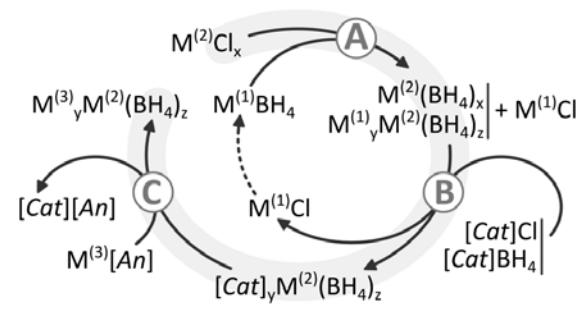
A mechanochemical approach to synthesis of borohydrides is the simplest and widespread way for obtaining homoleptic solvent-free borohydrides [4,5]. Such approach, despite being fast and efficient, shows also serious drawbacks - the most important of them are difficulties with synthesis scaling up and purification of the product. Here we present a development of a method of synthesis mixed-metal borohydrides, M(3) M(2)(BH4)z, by room temperature wet chemistry approach, as shown in Fig. 1 [6,7,8]. This method is based on solvent-mediated metathetic reaction between salt containing weakly coordinating anion, M(3)[An], and organic derivative of metal borohydride, containing large organic cation [Cat]yM(2)(BH4)z (reaction C in Fig. 1). Here we compare both methods of synthesis, supported by IR spectroscopy, powder and single crystal x-ray diffraction, and thermal analysis including thermogravimetric analysis, differential scanning calorimetry and evolved gas analysis.
It is known, that the rare-earth metals have high magnetic moments and a diverse range of magnetic structures. Our experimental study utilizing the vibrating SQUID magnetometry revealed that rare-earth metal borohydrides may serve as novel magnetic materials as exemplified by alkali metal-lanthanide borohydrides of holmium [9] and ytterbium [10]. Our investigations indicate that strong mixing of Ln(4f) and H(1s) states, which is responsible for poor thermal stability of these materials, may, in some cases, lead to strong magnetic superexchange interactions between Ln(3+) centers via borohydride bridges.
We will also present our recent results on evaluation of organic derivatives of magnesium borohydride as precursors towards superconducting magnesium diboride coatings [11]. The experimental methods used for this study include x-ray photoelectron spectroscopy and heat capacity measurements (using the Physical Property Measurement System).
The results obtained point out to richness of possible practical applications of metal borohydride materials.