
Germanium nanowires are ideally suited for building nanoelectromechanical systems because of an advantageous combination of electric properties, high Young modulus, strength and stability. Examples of such nanoelectromechanical systems are a mass sensor [1] and a switch [2], where a single nanowire is employed as an active element. Their operation is executed by triggering frequency that matches the resonant frequency of the system. A major challenge to implementing these devices is that the nanowire resonant frequency changes significantly in response to small changes in the system, such as clamping of the nanowire end [3] or mechanical deformation. Hence it is an important parameter that should be controlled in order to perform stable operations on the nanoelectromechanical system.
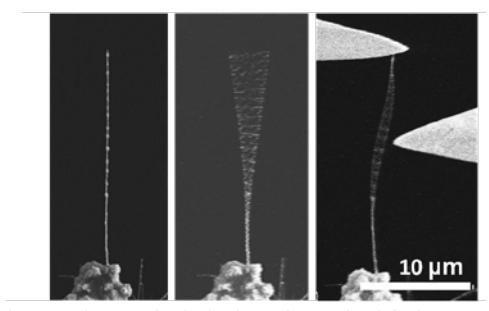
This work is focused on the investigation of the origins and causes of the nanowire resonant frequency shift for these nanoelectromechanical systems and their common influencing factors. To build a nanoelectromechanical system prototype gold electrodes and germanium nanowires are configured using a nanomanipulation system staged inside a scanning electron microscope. Vibrations of the nanowire are excited electrostatically and resonance detected from scanning electron microscope images (Fig.1). The nanowire being single-clamped or double-clamped represents common configurations used in the nanoelectromechanical mass sensor and the switch.
One of causes of the resonant frequency change is system mass change. The working principle of mass sensor will be demonstrated by depositing graphite microparticles onto the surface of a germanium nanowire resonator and detecting its resonant frequency shift. Another cause is the effect of nanowire deformation and permanent deflection owing to specific configurations of the electrodes and nanowire in the nanoelectromechanical system. We will demonstrate the correlation between nanowire deformation and resonant frequency. Finally, we will discuss the effect of clamping for a nanowire configured as a switch in ON state. Forcing electrical current flow through the system causes nanowire-electrode contact strengthening and a corresponding increase of the resonant frequency.
In summary, we will discuss the effects of the materials, configuration and operational conditions of nanoelectromechanical system and options for minimizing drawbacks. These results for germanium nanowires may also be applicable to other nanowire compositions.