
Active galactic nucleui (AGN) are compact central regions of galaxies. Their luminosities are much higher than these in normal galaxies. Moreover this parameter vary on very short timescales (less than a day) what puts tight constraints on the size of the emitting region as few light-days in diameter. The explanation is simple – the most efficient conversion of matter to energy is the accretion by a black hole which is in the center of AGN.
The picture below (Fig. 1) presents the scheme of AGN with the most popular division – the radio-loud/radio-quiet dichotomy and some subclasses of it.
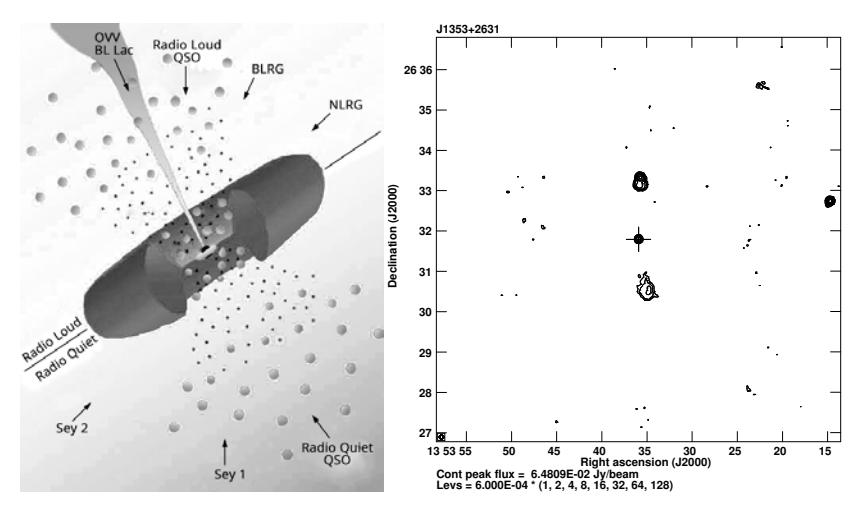
Radio loud AGNs with radio structures of enormous linear sizes, which projected linear sizes larger than 0.72 Mpc [2], are labelled giant radio sources (GRS, Fig. 2). Using the radio images of 60 GRSs extracted from FIRST (Faint Images of the Radio Sky at Twenty-Centimeters) and NVSS (The NRAO VLA Sky Survey) surveys, we found a few objects whose radio morphologies are nonstandard.
Here, we present examples of sources whose particular components appear to be at different stages of the source's evolution - in the transition from RL to RQ state. This is a firm evidence for AGN recurrent activity. Some GRSs belong to the double-double radio galaxy, due to a pair of double lobes with a common centre. The one of subclasses, sources with a strong central component and two visible lobes (classified as Fanaroff-Riley II sources [3]), are known as core-dominated triple. The radio lobes of two of the selected objects have a strange distribution which is hard to interpret and one object is characterized by well-developed morphology.