
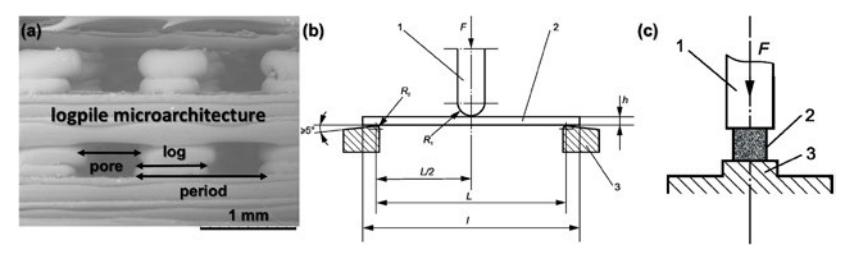
3D printing based on fused filament fabrication (FFF) is emerging as a tool for rapid prototyping as well as additive manufacturing. Recently its equipment cost has dropped to the level affordable for hobby usage at home. At the same time it offers 3D micro-structuring potential impactfull for scientific research in microfluidics, micromechanics and biomedicine. Commercially available and widely used FFF 3D printers enable straightforward patterning of objects having internal micro-architecture out of biodegradable polylactic acid (PLA or polylactide). It opens wide prospects for the creation of custom made biodegradable templates which are of great interest for cell growth and tissue engineering applications [1]. So far there has been no systematic study on mechanical properties of micro-printed PLA. Thus, in this work we aim to determine the mechanical properties of 3D printed PLA objects having various orientation log-pile microarchitectures applying standard testing equipments and following ISO defined procedures. We employ FFF 3D printer "Ultimaker” for the manufacturing of log-pile structures having 1.2 mm lattice period and ~50% fill factor as shown in Fig. 1(a). Bending and compressive response of the specimens tests are examined using universal "TIRAtest2300" machine, the corresponding principle measuring schemes are depicted in Fig. 1(b,c). Note that non-100% filling factor means the object itself is respectively lighter and at the same time requires proportianally less material to produce it. Employing additive manufacturing techniques it is inherently micro-porous having pores of defined shapes and dimensions.
| Type of micro-architecture | Flexural modulus (MPa) | Elastic modulus (MPa) | Stiffness (N/m $$\times 10^5$) |
|---|---|---|---|
| Log-pile body-centered cubic | 55 | 9.2 | 2.3 |
| Log-pile face-centered cubic | 380 | 7.8 | 1.9 |
| Log-pile rotating 60 deg | 410 | 23.1 | 5.7 |
In this work we 3D printed objects having internal log-pile geometries and experimentally measured stress-strain and load/displacement curves of such specimens. Within the limitation of the study we show that micro-architecture (variation of log orientation in respect to each other) can significantly modify the mechanical properties. Thus we prove that employing low-cost equipment and applying the same raw material one can create objects of desired rigidity. By means of additive manufacturing one can produce objects with specific micro-architectures which allows exploitation the structural advantages of stretching and compression constructions as well as size dependent strengthening effects [4].