
During the last decade, an impressive progress in the lighting technology based on the light-emitting diodes (LEDs) was achieved. Currently, the white LEDs have a considerable share of the light source market. Nevertheless, study and implementation of novel phosphors acting as wavelength converters in white LEDs is still one of the key issues in further development of these devices.
From the point of view of development of high power LEDs, glass ceramic materials have several advantages combining the properties of crystals and glasses. High thermal conductivity is of special importance. Recently, BaSi2O5 doped with Eu2+ and Eu3+ was found to be a good phosphor emitting in blue and red spectral ranges [1, 2]
We studied the influence of crystallization on the luminescence properties of Ce3+-doped stoichiometric glass BaO-2SiO2 at different stages of transformation from amorphous phase to glass ceramics. The samples were prepared by using 99.99% purity barium carbonate (BaCO3) and silicon oxide (SiO2) at stoichiometric molar ratio BaO-2SiO2. Cerium was added at the amount of 1 weight % over the crystal stoichiometry in the form of Ce2Si2O7, i.e., in the compound containing Ce in a trivalent state, in contrast to the conventional Ce2+ introduction using CeO2. Two samples were cut of the glass after fabrication and annealed in different conditions: 15 min. at 900 °C and 30 min. at 850 °C. Unannealed sample was also studied for reference. The samples were prepared in Belarus State University.
The samples were investigated using confocal luminescence spectroscopy. The mapping and study of spatial variation in photoluminescence (PL) spectra were performed using WITec Alpha 300 S microscope system operating in confocal mode. An objective with numerical aperture NA = 0.6 ensured the in-plane spatial resolution of ~250 nm. The microscope was coupled by optical fiber with a spectrometer followed by a thermoelectrically cooled CCD camera. A CW laser diode, emitting at 405 nm was exploited for excitation.
Typical defects of the glass have been detected and studied in the unannealed sample. The bandwidth of PL band from the areas surrounding structural defects is lower, and the peak position is slightly redshifted, when compared to PL from defect free areas (Fig. 1). The same features have been observed, when comparing the spatially averaged PL spectra from annealed samples with those from the reference sample. In both cases, the change in PL parameters is a result of crystallization: either around the structural defects acting as crystallization centers in unannealed glass or in the bulk of the sample due to annealing.
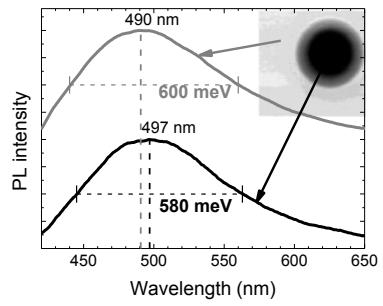
Comparison of PL from samples annealed in different conditions showed that the luminescence properties of these samples are similar. This indicates that the influence of crystallization on Ce3+ ion emission is insensitive the investigated annealing conditions. These features are favorable for application of this glass system as phosphor material with low sensitivity of spectral parameters to fabrication conditions.