
Li1.3Al0.3Ti1.7(PO4)3 is known as a good solid electrolyte with high lithium-ion conductivity [1]. This compound crystallizes into the so called NASICON-type structure, which enables lithium migration inside solid framework [2]. Its bulk conductivity reaches 10-3 S/m at room temperature [3]. However, the NASICON ceramics do not show very high total conductivity because it is limited at the grain boundaries. So the modification of ceramic grain boundaries is necessary in order to improve the total conductivity of Li1.3Al0.3Ti1.7(PO4)3 ceramics.
The aim of this work is to investigate electrical properties of Li1.3Al0.3Ti1.7(PO4)3 ceramics prepared by different synthesis conditions. Electrical properties of the NASICON nanoceramics were investigated by two probe impedance spectroscopy method in the frequency range from 10 Hz to 3 GHz and temperatures from 300 K to 740 K. Three dispersion regions were found in the impedance spectra of the ceramics. The one at the highest frequencies is related to ionic transport in the grains of ceramics, the other in the intermediate temperature range – to the ionic transport in grain boundaries, while the dispersion at the lowest frequencies corresponds to ion blocking effects at the solid electrolyte-electrode interface. So, the impedance studies in the broad frequency range allowes one to separate grain and grain boundary conductivities of the ceramics and their temperature dependences are shown in Fig. 1.
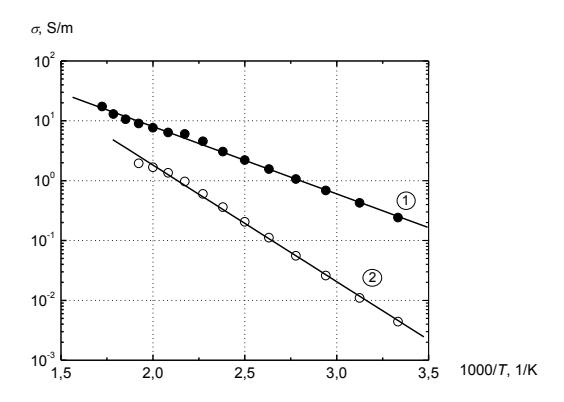
Both grain and grain boundary conductivities obey Arrhenius law in the investigated ceramics. The activation energies of conductivities were found from Arrhenius plots. The comparison of electrical properties for ceramics prepared by applying different their preparation conditions is presented.