
Carotenoids are organic molecules which can be found in cells of plants. These molecules are actively involved in photosynthesis acting as light-absorbers which protect photosystems. It can as well counteract the exited singlet oxygen molecule which has detrimental impact on biological systems. Carotenoids are organic pigments which determine colors of living organisms and reflect processes within living cells. The spectroscopic properties of carotenoids are mainly conditioned by polyene chain in the molecules but at the same time they are sensitive to the position of ending structures connected to ends of polyene chain and surrounding environment.
In recent years experimental methods for observing minor deformations in carotenoids' molecules while investigating electronic and vibrational resonance in Raman spectrum were developed. Resonance Raman spectrum enables researchers to distinguish specific modes related to molecule's conformation and structure.
The main objective of this research was to find frequencies of harmonic modes in a known active region of resonance Raman spectrum of β-carotene (Fig. 1), determine significance of anharmonicity for these modes and the change of frequencies in the second excited electronic state of molecule[1].
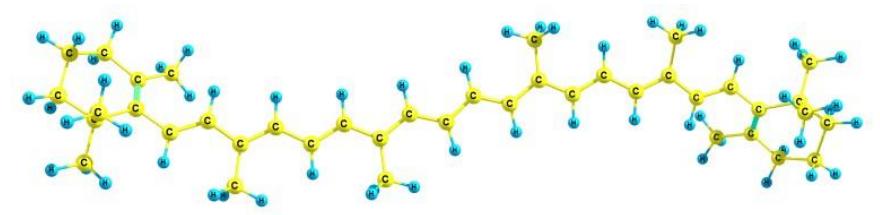
Gaussian09 [2] and Gamess [3] quantum chemistry packages at Vilnius University “HPC Saulėtekis“ supercomputer[4] were used in this work for the simulation and determination of these properties at DFT and TDDFT b3lyp/6-311G(d,p) level along with MacMolPlt [3] and Chemcraft [5] visualization programs for data analysis.
The modes corresponding to C=C and C-C valence oscillations of polyene chain mainly related to resonance Raman spectra during the first active PI-PI* electronic excitation were analyzed. The anharmonicity of particular modes were evaluated by numerical solving of vibrational Schrodinger equation along a particular mode. Evaluation of relative deviation from harmonic approximation showed that anharmonicity of vibrations in the ground electronic state is not significant.
As the harmonic approximation of vibrational spectrum is qualitatively applicable a further research on resonance Raman spectrum of β-carotene is possible in order to find out how rings at the ends of polyene chain and interactions with environment alter frequencies of highest intensities in the spectrum.