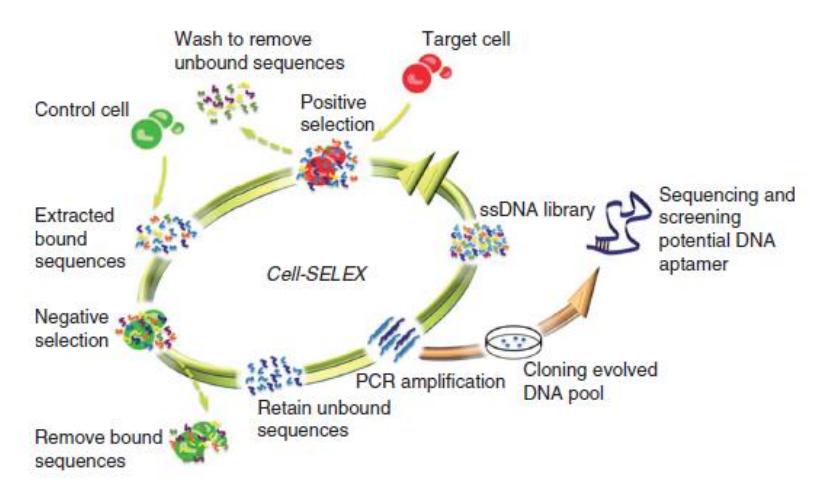
Aptamers – nucleic acids with molecular recognition, have over the past twenty years emerged as a versatile tool in biochemistry, medicine and nanotechnology. To find a specific sequence that folds into a three dimensional structure that is able to bind the chosen target, Systematic Evolution of Ligands by EXponential enrichment (SELEX), also referred to as in vitro evolution (or simply selection), is usually applied. The method enables isolating an aptamer of interest from a pool of randomized molecules by repeated steps of incubation with the target, partitioning and amplification, until the pool of molecules becomes enriched in a particular clone.[1]
Many variants of that technique was described recently – some of them are able to decrease the number of selection rounds, while others imply the use of modified nucleobases to enlarge the diversity of selected oligos, or modifications of the nucleic acid's backbone to prevent enzymatic degradation by nucleases.[2] Another variation is cell-based aptamer selection, termed cell-SELEX which is particularly promising strategy for various applications, including cancer research and therapy.
Bearing in mind that prior knowledge of the target molecules is unnecessary in cell-SELEX, the technique seems to be perfect for the discovery of native-state biomarkers.[3] During the lecture, we will track the entire selection process – from setting up a cancer cell culture up to the sequencing and preliminary analysis.