
Aerosol particles affect global climate, ecosystems and human health. The influence of aerosol depends on particle chemical composition and physical properties. Mass concentration trends of the main aerosol components and their correlations with black carbon (BC) were investigated to assess the contribution of the main carbonaceous sources in three different environments.
An Aerosol Chemical Speciation Monitor (ACSM) was used for continuous measurements of aerosol composition during 2013 – 2014 years. ACSM measures aerosol mass concentration and chemical composition of non-refractory submicron aerosol particles in real-time. It provides information about composition for particulate ammonium, nitrate, sulfate, chloride and organics. A Magee Scientific Company AethalometerTM, Model AE31 Spectrum, manufactured by Aerosol d.o.o., Slovenia, provided real-time, continuous measurements of the BC mass concentration. The optical transmission of carbonaceous aerosol particles was measured sequentially at 7 wavelengths (${\lambda}$ = 70, 450, 520, 590, 660, 880 and 950 nm). The concentration of BC corresponds to the 880 nm. Measurements were carried out in Preila, Rūgšteliškis and Vilnius which represent marine, rural and urban environments, respectively.
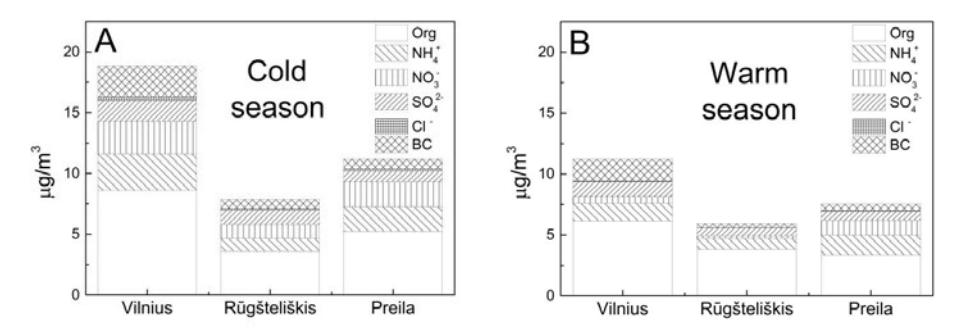
The annual data of main chemical components concentrations in three environments were divided into cold and warm seasons. The aerosol particles in Vilnius, Rūgšteliškis and Preila consisted mainly of organics (45.7%, 46.0% and 46.9%, respectively), NO3- (14.3%, 14.8% and 18.4%, respectively) and NH4+ (15.9%, 13.1% and 18.0%, respectively) during the cold season. The BC concentration in Vilnius was twice higher than in Preila and Rūgšteliškis. Meanwhile, during the warm season organic relative contribution increased to 54.8% and 64.3% in Vilnius and Rūgšteliškis, respectively. The BC relative contribution decreased up to 5.5% and 6.0% in Rūgšteliškis and Preila, respectively.
Thus, it can be concluded that the main chemical component in all three environments during both seasons is organics. Moreover, during the cold season the BC concentration was affected by local sources (mainly domestic heating and traffic) and during the warm season the contribution of the local sources is lower.