
Drug degradation represents a serious problem, which relates to the loss of the pharmacological activity and the possibility of adverse effects induced by the resultant degradation impurities [1].
The problem of API degradation is discussed all over the world nowadays and is strictly controlled by internationally recognized ICH guidelines [2]. Furthermore many pharmacologically active ingredients are also photolabile and can undergo degradation initiated by electromagnetic radiation.
In this study the photodegradation of furazidin, furazolidone and nitrofurazone is discussed. These nitrofuran derivatives possess antibacterial and bacteriostatic properties and are widely used in the treatment of different diseases such as: lambliosis, salmonellosis, trichinosis, dysentery and others. The mechanism of nitrofuran influence on human organism is not completely investigated, but there is a hypothesis, that these compounds can inhibit the enzymatic processes in bacteria [3].
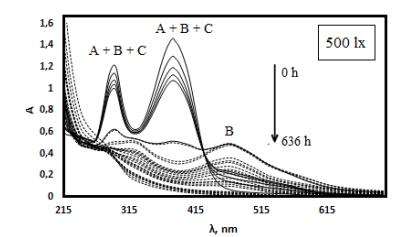
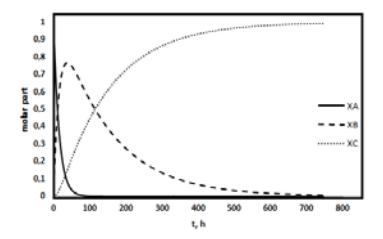
The photostability of furazidin, furazolidone and nitrofurazone in isopropanol and acetonitrile medium was studied using UV/VIS spectroscopy; the qualitative and quantitative analysis of furazidin photodegradation was investigated by UPLC - Tof - MS; Runge – Kutta method combined with multi-parameter optimization method was applied to obtain kinetic models for furazidin, furazolidone and nitrofurazone photodegradation and to determine kinetic parameters of the process.
Chromatographic analyses were performed on a modular UPLC system, Agilent 1290 Infinity series (Agilent Technologies). LC separations were achieved by using an X Terra MS C18 column ($2.1 \times 150$ mm, $3.5$ μm) with a mobile phase composed of deionized water (channel A) and acetonitrile (channel B) in a gradient mode at a flow rate of $0.3$ mL/min. The detection was monitored at 210, 254, 292, 380, 395, 470, 550 nm.
The mass spectra (HRMS) were taken on an Agilent 6230 TOF LC/MS (Agilent Technologies) with electrospray ionization (ESI) in positive mode.
Electron spectroscopic analyses were performed on Perkin Elmer Lambda 25 (PerkinElmer, Inc., United States of America) UV/VIS spectrometer. The detection was monitored in the wavelength range 190 – 700 nm.
Successful application of described methods illustrates the usefulness of photodegradation study and lets to conclude, that the methods are suitable for investigation of photostability of API and can be used in industrial drug synthesis.