Over recent years a big increase in usage of nanoparticles, varying in size and shape, is evident. In many applications where nanoparticles are used it is necessary to have them in defined positions on the surfaces. Therefore, efficient methods of well-controlled deposition have to be investigated. One of such methods is capillary force assisted assembly from colloidal solutions [1]. During this process, a small volume of nanoparticle colloidal solution is translated over a substrate with or without nanostructures at a certain temperature. Depending on the substrate surface properties, nanorelief and deposition conditions, nanoparticles can organize themselves in well-defined designated positions or in tightly packed monolayers on the substrate surface. Such arrays of micro and nanoparticles are used as drug delivery systems [2], SERS sensors [3], security features [4], etc. This paper presents results achieved using a capillary force assisted assembly system and polystyrene micro particles.
The setup applied in this work consists of precise motorized linear translator, controlled temperature sample holder and imaging system. Everything is set up on an anti-vibration optical table. Motorized translation stage that is able to move at speeds <0.001 mm/s, is assembled under the optical microscope with CCD camera on manual XY positioning stages for comfortable positioning under the microscope. The drop of colloidal solution is placed under the glass piece that can be manipulated adjusting the distance to the sample and angle of inclination. Controlled temperature sample holder fixed on the motorized translation stage slides with respect to the glass slide. The temperature control is performed employing a thermoelectric thermostat via software for temperature control input and monitoring. Results were investigated using optical and scanning electron microscopes.
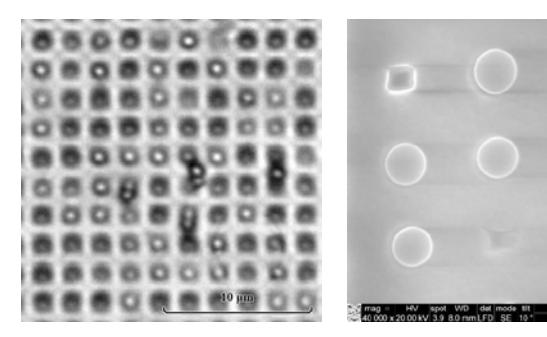
The micro particle deposition from colloidal solution was carried out on patterned polymeric substrates that were formed using soft lithography replication processes from the silicon shim. Periodic structures of 560 nm width pits repeated with 1.8 μm pitch were patterned in poly-dimethyl-siloxane (PDMS). 700 nm polystyrene microbeads from 0.77 wt% colloidal solution were deposited at 12 μm/s translation speed and 40°C temperature on the polymer template with reasonable reproducibility. Further investigation is required to increase yield of controlled particle deposition.