Nowadays the main energy sources for mobile aplications are based on hydrocarbons, either in gaseous or liquid state. Facing the limited amount of available hydrocarbons left one must develop new ways for onboard energy storage. In this particular field hydrogen is one of the best candidate considered [1]. In the age of growing ecological awareness it is important that the only product of hydrogen combustion is water vapour. The second great advantage of hydrogen over petroleum is its very high gravimetric energy density. Hydrogen is therefore considered as a fuel of the future.
For full replacement of hydrocarbons by hydrogen efficient ways of producing, storing, distributing and combusting hydrogen must be developed. Here, we focus on chemical hydrogen storage in solid materials. New candidates for storage materials must meet all standards defined by the U.S. Departament of Energy (DOE targets) [2]. The most important among those are the high gravimetric and volumetric densities of hydrogen in the storage systems. Ammonia borane (NH3BH3) and its derivatives are among the most promissing hydrogen rich materials [3,4,5]. One serious disadvantage of these materials is that contaminants (borazine, ammonia) are evolved upon thermal decomposition along with hydrogen gas [6].
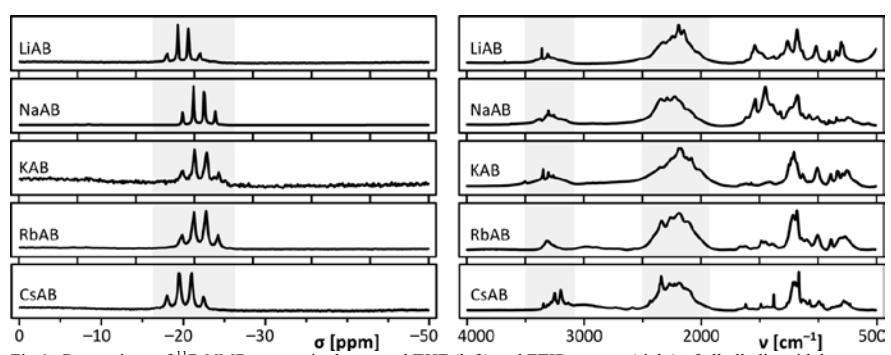
We managed to synthesize and characterize (FTIR, RAMAN, TGA, PXD, NMR) all alkali amidoboranes (MNH2BH3, shortly MAB) [4,6,7]. We determined optimal synthetic profiles and conditions leading to the desired products (Eq. 1–3):
$$M = Li \qquad MNH_{2} + NH_{3}BH_{3} \rightarrow MNH_{2}BH_{3} + NH_{3} \tag{1}$$$$M = Na, K \qquad MH + NH_{3}BH_{3} \rightarrow MNH_{2}BH_{3} + H_{2} \tag{2}$$$$M = Rb, Cs \qquad M + NH_{3}BH_{3} \rightarrow MNH_{2}BH_{3} + 0.5H_{2} \tag{3}$$In this presentation we show for the first time a detailed comparison of physicochemical properties of all alkali amidoboranes and then evaluate them as hydrogen storage materials with respect to DOE targets. We focus on gravimetric hydrogen capacity, temperature of hydrogen evolution and the purity of the hydrogen desorbed. Results presented here will constitute Mr. R. Owarzany's Masters thesis [8].
To broaden our knowledge about this family of compounds we also characterized products of thermal decomposition of alkali metal amidoboranes. We made an attempt to fully dehydrogenate alkali amidoboranes to obtain amorphous boron nitride (a-BN) in a way shown before for ammonia borane [9]. Our lastest results are promising, but further investigation is needed.