
Research have been performed with the aim to detect physical features of properties of ZnO crystals with transition metal impurities. It was carried out via ab initio simulation for seeking the conditions and parameters of the optimal technology for creation of the materials with required functional properties for spintronics and sensor devices.
Zinc oxide is the wide-gap semiconductor, which demonstrates properties of high-temperature ferromagnetic both in its pure form and in the presence of magnetic impurities, such as Fe, Co, Ni and Cu. These impurities are the transition elements with incompleted d-orbital.
Computation have been performed using density functional theory (DFT) via the programm complex VASP, which is intended for quantum (QM) and molecular mechanics (MM) simulation.
On the first stage the structure relaxation of the investigated systems have been performed. Zinc oxide super-cell has been constructed. It contains 128 atoms. Some atoms in super-cell were replaced on transition metal atoms (Fe, Co, Ni, Cu).
The second stage is static calculation, where local density approximation was used with Hubbard correction of 7.5 eV for zinc d-orbital and of 2 eV for oxygen p-orbital.
In the case of Ni and Fe, magnetic moment increases monotonically with an increase in the number of introduced atoms. In the case of Co and Cu, value of magnetic moment of super-cell with four introduced atoms is lower than it for super-cell with three introduced atoms. In the case of specified ferromagnetic states, clusters consisting of three and four Cu atoms and of four Co atoms aren't advantageous energetically.
ZnO: Fe (3,13), ZnO: Co (2,34) have the largest magnetic moment (9,5 μB, 8.1 μB for super-cell of 128 atoms) and these systems are the most stable among the studied ones..
During the simulation of the ZnO:Ni(x) systems with different variations of x value it was established that systems are stable at the antiferromagnetic state. Figure 1 is a graph showing the DOS of the system ZnO: Ni (1,56).
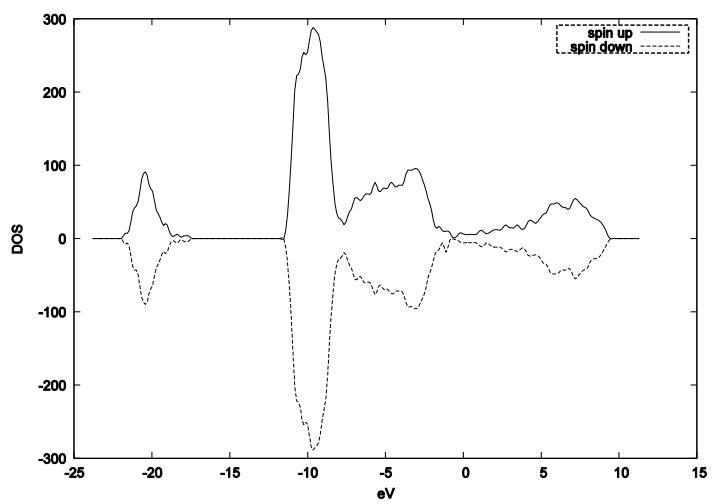
It is easy to notice that narrow d - bands are mirrored relatively to the x-axis. A small perturbation in the form of the asymmetry of two curves, is notably on the border of sp-zone. Supposedly this can be associated with the stoichiometry violation during the introducing of the impurity atoms.