Ellipsometry is a non-destructive optical method for investigation of optical properties of various materials. It is most commonly used for determination of refractive index and thickness of thin films [1]. In this work, spectroscopic variable angle ellipsometer GES5E (Semilab) and Spectroscopic Ellipsometry Analyzer (SEA, Semilab) software were employed for determination of refractive index and extinction coefficient dependences on wavelength dispersion curves, thickness of DLC:Cu nanocomposite films and copper filler content.
DLC based Cu nanocomposite films were deposited on quartz substrates using magnetron sputtering technique of Cu target with argon ions in acetylene gas atmosphere [2]. The thickness of the films were investigated using transmission electron microscope (TEM). In order to investigate optical properties, optical models of structures were created in SEA software. The optical model of the structure was varied until the measured and modelled $Ψ$ and $∆$ plots had a good fit with each other [3]. Nanocomposite DLC:Cu film was described by Effective Medium Approximation (EMA). For copper filler refractive index and extinction coefficient values from database were used. DLC matrix was described by dispersion laws (Drude or Adachi).
In experimental measurement, every sample was investigated in 4-5 microspots and using parallel beam. The ellipsometric parameters were derived for 10 different angles of incidence. Since all of these angles were used to measure at the same spot, they all were fitted at the same time using the same optical model in order to obtain more reliable result.
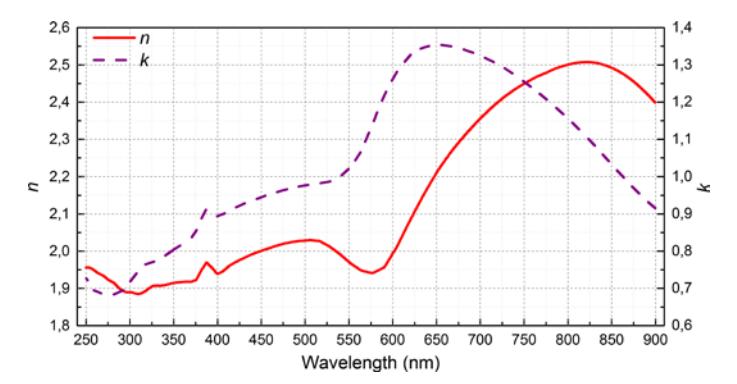
After fitting, various parameters of the investigated nanocomposite film were obtained. The derived thickness was compared with TEM results. The differences are less than 10 %. The dispersion curves of refractive index and extinction coefficient (see fig. 1) were defined and compared with optical absorbance measurements obtained with UV-VIS-NIR spectrometer.