
In this paper we used laser assisted techniques for production of gold and alloyed gold-silver nanoparticles (NPs) in ionic liquid (IL) (1-n-butyl-3-methylimidazolium bis(trifluoromethylsulfonyl)imide [C4C1Im] [Tf2N]). Gold NPs have a wide range of applications, ranging from charge storage systems, sensing of organic and biomolecules, to photonic device fabrications. Studying of Ag-Au alloys is of special interest due to the possibility of altering of their physical properties by varying the composition and atomic arrangement.
To prepare NPs we used laser irradiation processes in several ways: first, laser ablation of metal target immersed into IL, second, laser induced sputtering of the preliminarily prepared gold NPs deposited on glass and placed under IL layer and finally additional laser irradiation of the NPs formed in IL with laser light at frequency of the surface plasmon resonance. In order to synthesize nanoparticles of Ag-Au alloy the Ag and Au colloids, prepared by laser ablation in ethanol, were mixed in the proportion 1:1 and deposited on the glass substrate. After complete drying of the powder it was sputtered by the unfocused beam of the second harmonic (wavelength 532 nm, pulse duration 10 ns) of the Nd:YAG laser in IL. The produced colloidal solution was additionally subjected to laser irradiation by the second harmonic of the Nd:YAG laser with fluence of 400 mJ/cm2.
The optical properties, morphology and size distributions of the synthesized nanoparticles were investigated using UV/VIS absorption spectroscopy and transmission electron microscopy (TEM). To determine the temperature of the laser irradiated NPs their thermal radiation spectra were fitted by a Planck curve, taking into account the emissivity function of NPs.
Optical extinction spectra of the synthesized gold colloids exhibited the characteristic peaks of the surface plasmon resonance (SPR) on the tail of the broad band extending toward the UV-wavelength range and originating from the interband transitions in NPs. The SPR peak position was around 550 nm indicating the formation of particles with dimensions of 5–20 nm. The plasmon peak position was found to be sensitive to the additional laser irradiation. The blue shift of the SPR maximum and narrowing of the red tail of the band after 532 nm irradiation can be attributed to the depletion of the particle aggregates and fragmentation of parent NPs into smaller ones after the additional laser irradiation. These spectra findings were confirmed by TEM data.
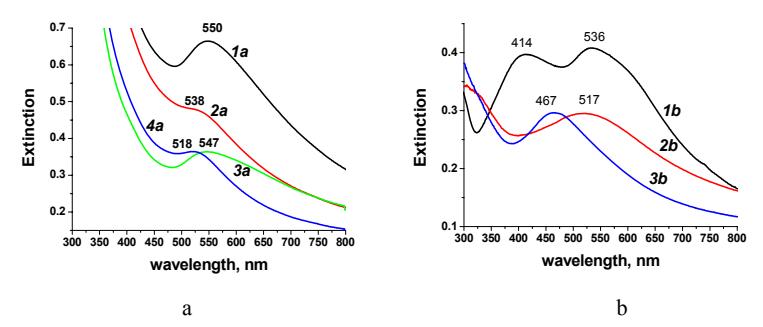
The optical absorption spectra of Ag-Au colloidal solutions before and after laser modification are presented in Figure 1b. As can be seen from the spectra of the mixture of gold and silver colloidal solutions, two distinct plasmon peaks appear in the spectrum (curve 1b). Laser sputtering of the Ag-Au powder under the layer of IL results in the sufficient changes of the absorption spectrum (curve 2b): instead of two plasmon bands only one is seen in the spectrum with a maximum at 517 nm that is indicative of the alloying of NPs [1]. The plasmon band is rather broad and red shifted that is indicative of the formation of Au-rich alloys with a relatively broad size distribution. After 532 nm laser irradiation a sufficient blue shift of the plasmon band takes place (curve 3b) that can be result of the change of Ag:Au ratio in the nanoparticle.