The demonstration of stimulated emission in conjugated polymers and low-molecular-weight compounds makes these materials promising as high gain media for solid-state lasers [1-3]. To date, optically pumped lasers based on conjugated organic materials have been demonstrated in both solution and thin films. With continuous efforts in pursuing electrically pumped organic lasing, luminescent organic semiconductors with improved characteristics, such as lower thresholds of stimulated emission, enhanced carrier mobility, and further improved thermal stability are constantly desired. Organic lasers can be potentially compact and ready for integration with other optoelectronic devices since amorphous films permit deposition on a variety of substrates. Broad gain spectra accompanied by the numerous choice of organic lasing materials offer wide emission-wavelength tunability across the entire visible range. Another great advantage of organic lasers is negligible temperature dependence of stimulated emission threshold, output power and emission wavelength [3], which is a result of molecular origin of the electronic transitions, i.e., strongly localized excited states (excitons), involved in light emission. Such organic laser sources may eventually compete with inorganic semiconductor lasers in a number of fields, e.g., spectroscopy, optical data communication, memory, sensing and displays [3].
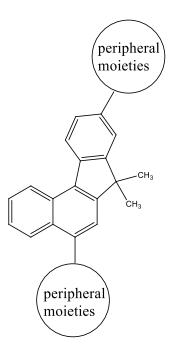
The current work focuses on the investigation of benzo[c]fluorene class of compounds (see Fig. 1) and their suitability as gain media. The measurements of amplified spontaneous emission (ASE), a type of mirrorless lasing, for a series of benzofluorene derivatives possessing different peripheral moieties were performed in dilute tetrahydrofuran (THF) solutions and polystyrene matrix at different compound concentrations (0.5-100 wt%). Polystyrene films were prepared by spin-coating technique on glass substrates. ASE measurements were carried out in the edge configuration, i.e., a cylindrical lens was employed to focus the excitation beam into a thin stripe with dimensions of $0.04 \times 12 \text{ mm}^2$ onto the sample near its edge, whereas the amplified emission were collected from the sample edge (in the direction perpendicular to the excitation beam). The emission spectra were measured as a function of the pumping intensity by using an optical fiber, which was coupled to a CCD spectrometer. The additional optical techniques such as absorption and fluorescence spectroscopy, fluorescence quantum yield $(\Phi_F)$ and fluorescence lifetime were employed to reveal the structure-property relationship of the compounds.
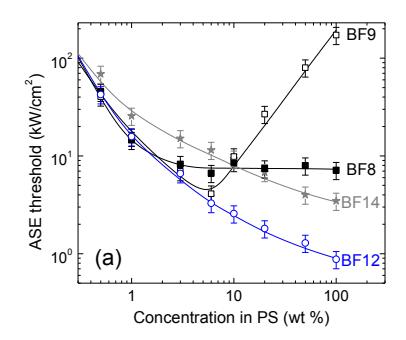
Concentration quenching measurements of all the benzofluorenes revealed very low quenching of $\Phi_F$ with increasing compound concentration in polystyrene matrix. An increase of the concentration from 0.5% to 100% resulted in a less than 2-fold drop of $\Phi_F$ (roughly from 75% to 45%) and of fluorescence lifetime (roughly from 1.5 to 1.0 ns). Estimated radiative relaxation rate was up to $0.7 \times 10^9 \text{ s}^{-1}$, which is considered as high and promising for lasing materials. ASE threshold as a function of compound concentration for the studied benzofluorenes is shown in Fig. 2. Importantly, some of the benzofuorenes demonstrated the lowest threshold (down to 900 W/cm2) in the neat films. This value is considered as one of the lowest ASE threshold values up to date achieved in the neat films.