
Polymer materials are nowadays applicable to many areas of modern technologies. It is motivation for investigation and understanding their internal processes. Resulst of experiments connected with nonlinear optics effects of host (polymer) - guest (dipoles, photochromic dyes,) systems are difficult to explain. Also the investigation of polymer systems behavior and properties for various temperatures (glass transition, diffusion of: particles, center of mass, guests,) seems to be a complex task.
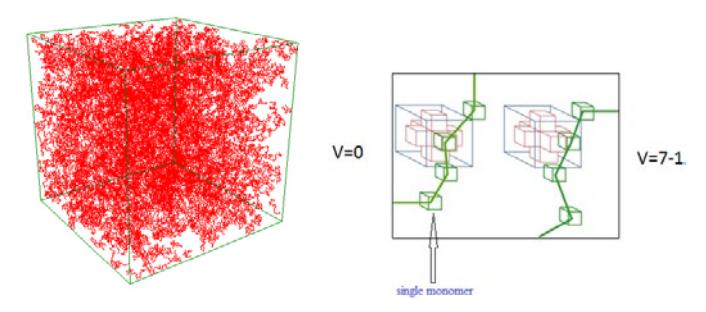
Through computer simulations we attempt to explain those problems. Description of model and system's preparation will introduce into so-called local void problem - roughly speaking empty space in the system. Approaches from literature will be compared with the one we want to apply.
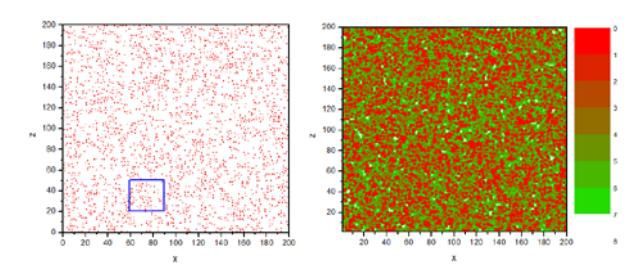
Results obtained with local void parameter show that there is strong correlation between monomers positions and regions of red color (Fig. 2, left), what is a straightforward consequence of its definition. What is more important, areas of white/green color are correlated with empty space in the system (Fig. 2, right). Groups of empty cells are the key for optical effects explanation and proper system's description.