
Terahertz (THz) radiation has a huge potential for a variety of applications, such as biomedical imaging, security imaging, spectroscopy and etc. Therefore, it is necessary to develop room-temperature terahertz sources and detectors [1].
From various novel approaches devoted for the development of high-frequency electronics, much attention has been addressed to graphene [2]. This is quite attractive material due to its high room-temperature mobility (up to 10 000 cm2/(Vs) on SiO2 wafer) and high carrier saturation velocity with already proven ability to detect THz radiation up to 3.11 THz [3]. It was reported recently that graphene field-effect transistors (GFETs) can be used for efficient detection of 600 GHz radiation showing performance matching with the state-of-the-art detector technologies for room-temperature operation [4].
This work is devoted to the more detailed study of devices presented in [4]. Here we concentrate on the peculiarities of the response to electromagnetic radiation spanning from 100 GHz to 1 THz. Continuous wave THz system TERABEAM 1550 was used to carry out the experiment.
Figure 1a presents dependencies of resistance for three samples with different value of Dirac point (CNP). Respectively are given voltage responses at frequencies between 0.1 THz and 1 THz at Fig. 1b – d, which for the purpose of clarity are normalized to the response at one specific point of the gate bias ($V_{gs} = 0$ V).
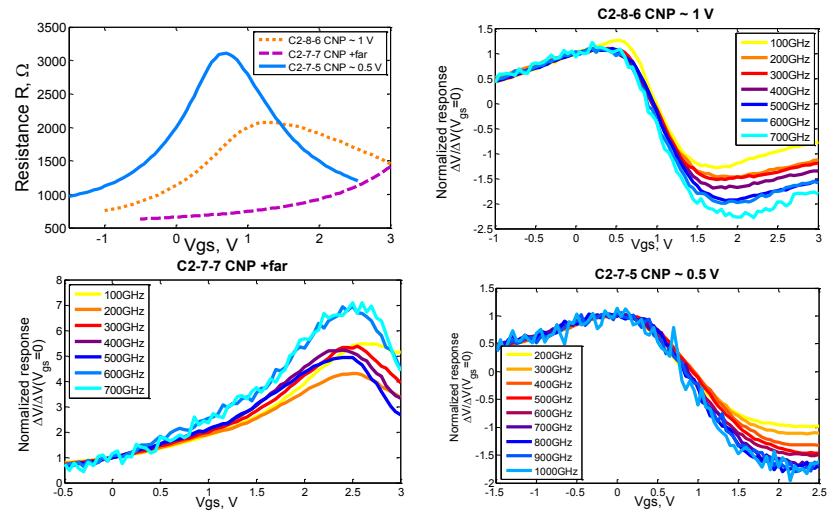
In conclusion, it is notable that G-FETs can be used for the efficient detection of THz radiation at room temperature even without applied voltage Vgs (completely zero-bias detectors). These measurements also show that G-FETs have interesting asymmetric response, which is frequency dependent and is more pronounced at higher frequencies. Such effect could be explained by the diffusive contribution of hot carriers (hot-carrier Seeback effect).