
S. Enterica – one of the most common food born pathogens. According to European food safety authority this gram negative bacteria causse 100 thousand illnesses in EU each year. Conventional food decontamination methods are not always safe and effective. It enforces reserchers across the world explore inovative methods for food safety. One of the most promising and environmentally friendly methods is photosensitization [1]. Thus the aim of this work was to evaluate inactivation of Salmonella Enterica using photoactivated chlorophylin-chitosan complex (Chl-CHS).
Chlorophylin (Chl) is a green food colorant, also known as food additive E141 [2] and chitosan (CHS) is biodegradable, nontoxic biopolymer widely-used as an antimicrobial agent [3]. Both materials are considering safe for people and compatible with food. It was shown that photosensitization itself is effective against gram positive pathogens but not against gram negative [4]. CHS was used to ensure close Chl localization to the target since close vicinity is crucial for the effectiveness of photoactive dye.
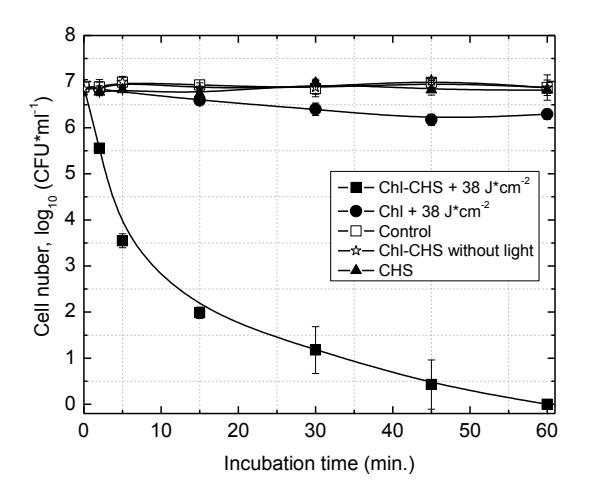
Samples with bacteria and Chl or Chl-CHS complex were illuminated by 405 nm light, dose 38 J·cm-2. Spread plate method was used to evaluate the effectiveness of 0.001 % Chl alone, 0.1 % CHS alone, and 0.001% Chl-0.1% CHS complex. Results are presented in Fig. 1. CHS alone did not affect S. Enterica since the result is the same as control. Chl alone has a small effect on S. Enterica, it shows 0.5 log reduction from control samples. In contrast Chl-CHS complex shows S. Enterica inactivation until undetectable level. These results demonstrate synergetic antibacterial effect of Chl and CHS which could rely on complexation. Soluble conjugates of Chl-CHS contain positive charge and bacterial cell wall contains slightly negative charge. Such conditions let them bind through electrostatic forces.
Since this food decontamination method is non thermal, cost effective and uses non hazardous compounds it has a huge perspective to be applied for food safety.