
Hydroxyapatite (Ca10(PO4)6(OH)2, HAp) is biocompatible and bioactive ceramic material widely used for dental, maxillofacial or orthopaedic applications [1]. However, pure HAp has unsatisfactory mechanical properties – it is a very brittle ceramic which is strong in compression and weak in tension [2]. To overcome this issue many different inorganic-organic composite materials with altered mechanical properties have been proposed [3]. Scaffolds - bone graft substitutes – made from such composite materials should possess precisely tunable chemical and physical properties in order to promote the migration, proliferation and differentiation of bone cells for hard tissue regeneration [4].
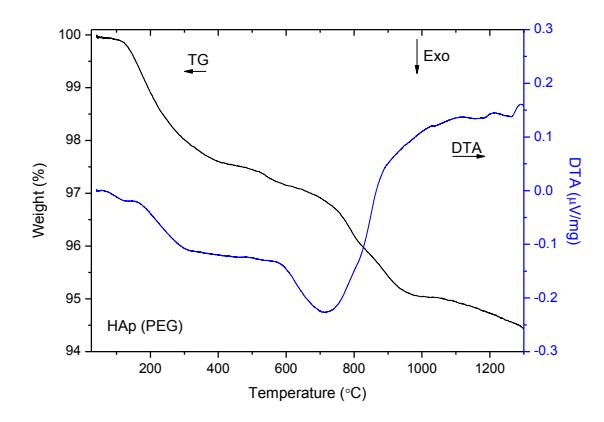
In this work we present a polymer-matrix mediated synthesis of nanocrystalline hydroxyapaptite (nHAp) via co-precipitation method. Prepared hybrid gels containing nHAp particles were calcined at 400-800 °C. An effect of the polymer (poly(ethylene glycol) (PEG) and polyvinyl-alcohol (PVA)) on nucleation and growth of HAp particles, crystallinity and phase purity of calcined material has been investigated. Calcination temperature, morphology, crystallinity and phase composition of the HAp powders were studied by thermogravimetry (TG) and differential thermal analysis (DTA) (shown in Fig. 1), scanning electron microscopy (SEM), Fourier transform infrared (FTIR) spectroscopy and X-ray diffraction (XRD) techniques.
Synthesised nHAp powders were further used to produce inorganic-organic hybrid materials by direct laser writing (DLW) technique. Biodegradable polymers such as poly(lactic acid) (PLA) and poly(glycolic acid) (PGA) were used as an organic matrix. Various processing conditions are examined and the effect of various processing factors on the materials cross-linking and structural properties will be also presented and discussed. The proposed approach demonstrates the prospects of composite material laser fabricated scaffolds for hard tissue engineering [5,6].