
Terahertz (THz) radiation is a frequency range between microwave and far infrared of the electromagnetic radiation spectrum. Properties of THz radiation (non-ionizing radiation, characteristic material spectral lines, propagation through materials which are opaque for other frequency ranges) make it relevant for material science, security systems and medical applications. For the purpose of implementing compact THz imaging systems there is a necessity of compact passive optical elements [1]. The problem of manipulation of THz radiation can be solved by using refractive (mirrors, lenses) or diffractive (Fresnel zone plates) optics. Since zone plates have a flat surface, it is simplier to construct compact systems based on them in comparison to conventional lenses with added advantages of reduced weight.
In this work, properties of phase-changing Fresnel zone plates (FZP) were simulated numerically for 0.6 THz frequency. It was assumed that the zone plates were formed on Si and InP substrates by anisotropic etching. Finite-difference time-domain simulations were run using MIT Meep software to predict properties of the grooved zone plates and compare them with the conventional (metalized) zone plates. Our simulations predict a nearly twofold increase of the electric field amplitude in the focal point in case of phase-changing plates (Fig. 1). In addition, anisotropic chemical wet etching was employed to evaluate possibilities to obtain structures required for creating simulated zone plates. InP samples were etched in HCl and H3PO4/HCl acid solutions [2]. After the experiment the etching profiles were investigated with optical and scanning electron microscopes (Fig. 2).
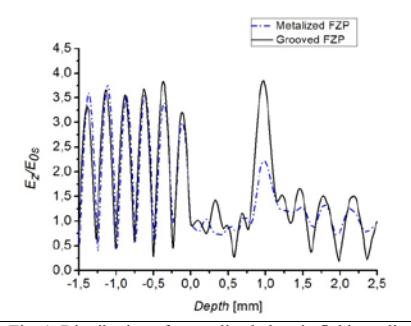
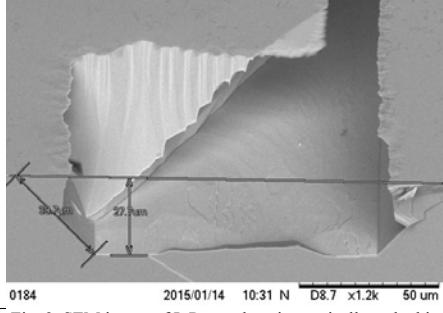
In conclusion, the results of simulations have showed better focusing properties for the grooved zone plates in contrast to metalized ones. Results of anisotropic wet chemical etching confirm the possibility of obtaining the required structures and depths of the order of tens of microns.