In this work we theoretically investigate temporal effects in optical parametric amplifier (OPA) pumped by incoherent wave in trapping regime. Analytical calculations have been performed as well as numerical simulations.
Trapping regime is a term for a situation, when signal and idler group velocities have different directions with respect to the pump wave. In Ref. [1], the parametric interaction of three coherent waves was investigated in cases when directions of signal and idler group velocities with respect to the pump wave coincide and when one of the relative group velocities of idler or signal are equal to zero. However, some of the formulas presented in Ref. [1] can be used in our analysis.
As initial conditions, we chose the signal and pump waves to be incoherent with the same correlation time $\tau_c$. We demonstrate through the numerical experiments, that in the case of trapping regime, the spectrum of signal and idler waves narrows in the process of OPA, thus the coherence of these waves is improved. The strength of this narrowing effect depends on the magnitudes of relative group velocities of signal and idler waves with respect to pump. The larger the magnitude of signal group velocity, the more spectrum narrowing manifests. However, as these group velocities grow, the amplification efficiency is also reduced.
In case of pump depletion, it is shown that the central part of pump spectrum is depleted, since the signal and idler spectra andergo narrowing in the amplification process. The width of that depleted central part depends on the spectral width of the idler wave. With the broader idler spectrum, the pump spectrum is used more effectively. This conclusion can be based on the phase matching conditions. The phase matching conditions are as follows:
$$k_1 + k_2 = k_3; \ \ \Omega_1 + \Omega_2 = \Omega_3;\tag{1}$$where the numbers 1,2,3 stand for signal,idler and pump waves respectively. $\Omega_j$ is the frequency and $k_j$ – the wave number of the j'th wave. If we expand the wavenumbers $k_j$ in Taylor series and consider that the first condition is satisfied at the central frequencies of pump, signal and idler waves, we obtain :
$$\begin{split} &\Omega_1 \!=\! -\frac{\kappa_2}{\kappa_1} \Omega_2; \\ &\Omega_3 \!=\! (1 \!-\! \frac{\kappa_2}{\kappa_1}) \Omega_2; \end{split}\tag{2}$$where $\kappa_j$ is defined as $\kappa_j = L_n/L_{\nu_j}$, where $L_{\nu_j}$ is the group walk-off length and $L_n$ is the nonlinear interaction length. The ratio $\kappa_2/\kappa_1$ can be expressed simply as $\kappa_2/\kappa_1 = L_{\nu_1}/L_{\nu_2}$. It is seen from Eq. (2) that the width of the idler spectrum depends on the ratio of relative group velocities. When $\kappa_2/\kappa_1 = -1$, the idler spectrum narrows along with the signal, and only the central part of the pump spectrum is depleted. In case when $\kappa_2/\kappa_1$ approaches zero, the idler spectrum remains broad and the larger portion of the pump spectrum is depleted.
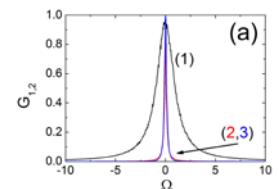
The numerical simulations have been carried out with various values of $\kappa_2/\kappa_1$, with only the first order of dispersion taken into account, as well as under real conditions in ADP crystal with second-order dispersion. Results of the first case are shown in Fig. 1. Is is evident from the numerical results that the narrowing of pump spectrum depends on the ratio $\kappa_2/\kappa_1$. As can bee seen from the Fig. 1, with the smallest value of $|\kappa_2/\kappa_1|$, the resulting idler spectrum is the broadest.