
Optical lattices are periodic potential distributions created by a set of interfering laser beams. Systems of ultracold atoms trapped in optical lattices provide a clean and controllable environment to reproduce a variety of quantum phenomena [1] known from other branches of physics, and often provide insights beyond the conventional knowledge. In our work, we analyze a square lattice where an artificial magnetic flux is created by means of periodic laser phase modulation (known as lattice shaking). The sign of the flux alternates in a checkerboard pattern. In this setup, relatively flat topо-logical energy bands are formed and thus the fractional quantum Hall effect (FQHE) may be induced without an external magnetic field.
The structure of the dynamic chiral-${\pi}$ lattice is shown in Fig.1. To induce complex hopping amplitudes between nearest neighbors (NN) the lattice is periodically shaken and a static energy shift for B sites (open dots) sites is introduced. The static energy shifts are cancelled by a gauge transformation, and the resulting tight-binding Hamiltonian features only time dependent-hopping amplitudes.
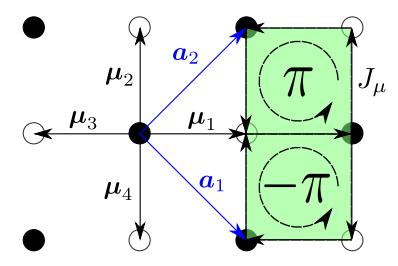
Application of the Floquet analysis produces an effective time-independent Hamiltonian which describes the long term dynamics of the system. Diagonalization of the effective Hamiltonian reveals the presence of topologically nontrivial energy bands which give rise to the integer quantum Hall effect (IQHE) and paves the way towards the fractional quantum Hall states.
The essential requirement for FQHE to occur is strong interaction between the particles. The interaction strength must significantly exceed the single-particle bandwidth. We construct the Hubbard Hamiltonian with three tunable parameters – the shaking frequency, shaking amplitude and the interaction strength, and set out to search for the parameter region where the degenerate ground state is separated from the rest of states by a large many-body gap and thus stable FQHE states may be formed.
To reduce the volume of numerical computations we have used interaction operator projection [2] into the relevant energy band and simplified method for calculation of topological properties [3].