
Terahertz (THz) frequency range which spans from 0.3 THz to 10 THz is still quite undeveloped and rarely used part in the spectrum of electromagnetic radiation. This is due to technological difficulties of creating a reliable and convenient sources and sensors of this radiation [1]. So far there are only a few alternatives of terahertz sources: backward wave oscillator, frequency multipliers, photo mixing devices, quantum cascade lasers and etc., none of them, however can operate in the whole THz frequency range. This work focusses on quantum cascade lasers.
Quantum cascade lasers (QCL) - are semiconductor devices that are characterized by high efficiency, small size, low price and can be produced in large quantities. They are grown by molecular beam epitaxy of alternating layers with different bandgaps and requires band structure engineering. QCL operation principle is based on intraband transitions. Charge carriers rolling down a potential staircase while sequentially emitting photons at the steps [2]. The steps consist of coupled quantum wells in which population inversion between discrete excited states is achieved.
Different types of noise can easily distort the expected characteristics of the laser, so one should make an effort to reduce their affect [3]. In order to do so, the noise research should be performed. Investigation of noise characteristics under varying parameters (like temperature or circuit current) allows to determine certain processes inside of the device, reveal the main origins of fluctuations, as well as to figure out some routes to improvement of noise characteristics of the device.
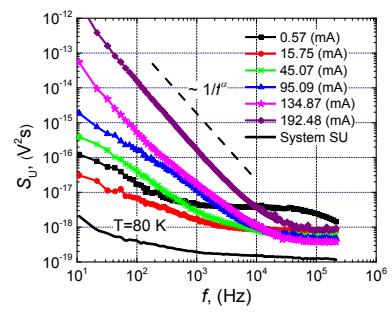
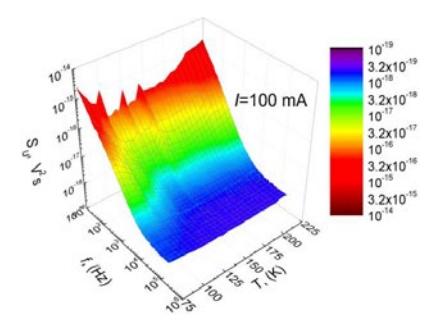
Figure 1 presents low-frequency noise spectra for a 3.41 THz QCL with bound-to-continuum design, with different bias current at 80 K temperature. The dependencies of noise spectra on the ambient temperature for fixed 100 mA bias are presented in Figure 2. Our studies have shown that in the investigated QCL devices low-frequency noise exhibit strong 1/f type character, which at high frequency range goes into the white noise.
We use two models to describe white noise in nonlinear systems: the shot noise model superposed with thermal noise of shunting elements sources and Gupta theorem. This comparison of experimental and modelled data indicates that Gupta theorem with the premise of the substantially higher electronic temperature than the lattice temperature can be used to describe experimental values more accurately than the shot noise model.