
Ionic liquids (ILs) have become extremely attractive study material in spectroscopy due to their tunable abilities and thus wide range of applications. Thus ILs are interesting media for the study of vibrational relaxation. In this work acetonitrile (AN) molecule was chosen as a "media sensitive" (thanks to its polarity) probe in ILs to carry out the AN C=N stretch (also known as υ2) vibrational relaxation investigation using polarized Raman spectroscopy. The vibrational relaxation time, or τvib, is given by the relation:
$${\tau_{\text{vib}} = (2\pi c \Delta v_{\text{iso}})^{-1},\tag{1}}$$were c is the speed of light and Δυiso is the half width at half maximum of isotropic spectrum, which is obtained from IVV and IVH (the two indices are for incident and scattered light, accordingly) Raman spectra.
Two different imidazolium based ILs (namely 1-butyl-3-methylimidazolium bromide ([BMIM]Br) and 1-decyl-3-methylimidazolium bromide ([DMIM]Br)) were chosen to enable the study of vibrational relaxation dependence on alkyl chain length. Moreover, different AN mass concentrations in AN/IL solutions (5% and 20%) and temperatures (295K and 328K) were used to assess AN C = N stretch vibrational relaxation dependence on temperature and AN concentration. Two-dimensional correlation analysis was used to determine the structure of υ2 band.
From the carried out experiments it was found that acetonitrile vibrational relaxation is faster in studied ILs
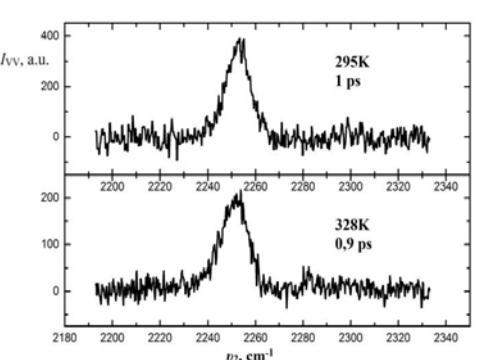
solutions (see table below) probably due to local ionic structuring [1]. Increased temperature of these solutions lead to even faster relaxation (see Fig. 1). Furthermore, the lengthening of alkyl chain of IL cation (in this case from 4 carbon atoms to 10) lead to faster acetonitrile vibrational relaxation as well, which could be due to the increase in degrees of motion of the cation (i.e., the larger the cation, the more degrees of motion it has for energy to distribute).
| ΔVVV, cm-1 | ΔVVH, cm-1 | τvib, ps |
|---|---|---|
| Neat AN | ||
| 1,65[1] | 6,1[1] | 3,2 |
| 2[2] | 7,25[2] | 2,7 |
| 2,48 | 6,17 | 2,14 |
| AN(20% wt)/[BMIM]Br | ||
| 4,13(4,33) | 5,32(4,57) | 1,31(1,26) |
| AN(5% wt)/[BMIM]Br | ||
| 3,71(4,18) | 4,32(4,87) | 1,7(1,3) |
| AN(20% wt)/[DMIM]Br | ||
| 5,43(6,01) | - | 0,98(0,88) |
| AN(5% wt)/[DMIM]Br | ||
| 5(5,73) | - | 1,06(0,93) |