
Room temperature ionic liquids (RTILs) are environmentally friendly solvents with unique chemical properties. They are chemically stable, electrically conductive, non-volatile at room temperature and their chemical and physical properties can be easily modified [1]. For applications of RTILs, it is very important to understand the relationship between the structure of the ionic compounds and properties of the underlying liquid. Molecular dynamics simulation is one of the means to find these links.
Molecular dynamics simulation is a very widely used method that allows us to model the structures and dynamics of different molecular systems. Reliability of results depends on the type of chosen force field which typically involves two types of interactions – electrostatic and van der Waals, which are described by Coulomb and Lennard-Jones potentials, respectively. The problem of force field parameterization is particularly relevant for simulating structure and dynamics of ionic liquids.
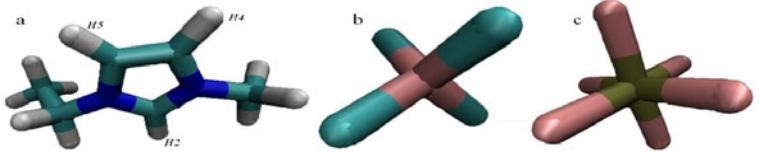
In this work we have used Amber simulation software for molecular dynamics simulations. We have investigated three types of RTILs: [C2mim][BF4], [C4mim][BF4] and [C4mim][PF6] (Fig. 1). Force field parameters were taken from Z.Liu et al. [2]. The obtained results allowed us to calculate density of ionic liquids, radial distribution functions and diffusion coefficients. Estimated densities coincided with the results of [2] and the experimental results. We have typically simulated systems consisting of 128 ionic pairs, but also of 256 pairs. We have also varied the cut-off value of van der Waals interactions. In all these cases, the results were similar, which leads to the conclusion that the system consisting of 128 ion pairs is large enough to reliably estimate the structural parameters of the system.
Concerning radial distribution functions and coordination numbers, the most interesting are the H2, H4, H5 hydrogen atoms that are in the imidazole ring (Fig. 1) and the fluorine and phosphorus atoms of anions. It was noticed that the probability of finding any anion around H2, H4, H5 chemical elements is greater in [C2mim] case than [C4mim]. It is likely that this is due to a shorter alkylic chain, which in this case have a smaller impact on the movement of surrounding compounds. Coordination number of boron or phosphorus around atom H2 is almost 2. Looking at the boron or phosphorus radial distribution functions we observe more structured distribution of anions as compared to fluorine.
| D (10-11 m2s-1) | |||||
|---|---|---|---|---|---|
| RTILs | Z. Liu et al. [2] | 128 | 256 | ||
| 10-50 ps | 40-100 ps | 10-50 ps | 40-100 ps | ||
| [C2mim][BF4] | 0,9 | 3,79 | 4,24 | 2,21 | 1,75 |
| [C4mim][BF4] | 0,8 | 3,80 | 3,90 | 1,79 | 1,81 |
| [C4mim][PF6] | 1,0 | 3,10 | 3,53 | 1,80 | 1,73 |
We have also evaluated the anion diffusion coefficient (D) which allows us to evaluate how much material's center of mass per unit of surface diffuses in the time interval. The diffusion coefficient is found from the tilt of the linear part of the mean square displacement function (MSD). As shown in Table 1, our results differ from Z.Liu et al. [2] by 2 or even 4 times, depending on the number of ionic pairs participating in the simulation or the selected time interval. We can conclude that the authors of [2] for statistical diffusion coefficient calculation have chosen an insufficient amount of ionic pairs and too short time period for MSD. The best results are found by finding tilt function in MSD 40-100 ps. It is noticed that the diffusion coefficient of anions in ionic liquids is two orders of magnitude lower than the atomic ions (eg. for NaCl anion $D = 2 \times 10^{-9} \text{ m}^2\text{s}^{-1}$), which shows that the center of gravity in ionic fluids diffuses much more slowly.