
In this work a possible human serum albumin binding site for chromophore acridine yellow was investigated via quantum mechanics - molecular dynamics calculations (QM/MM). This was done by calculating the excitation energies of acridine yellow and by comparing the maximum absorption energy shift, going from aqueous to protein environment, with experimental results.
The geometry of acridine yellow was optimised in vacuum of the HF/6-31G* level of theory via “Gaussian09” program [1] and atom charges were assigned using RESP (Restrained Electroscatic Potential) method for HF/6-31G* based electrostatic potentials using “Antechamber”. Afterwards, molecular dynamics simulations were run in a rectangular cuboid box with periodic boundary conditions to sample the phase space of acridine yellow in water solution. Molecular dynamics simulations were done with “Amber12” [2] package and consisted of equilibration and production runs, the latter lasting 1200 ps. Non-polarizable TIP3P potential for water was used in these simulations.
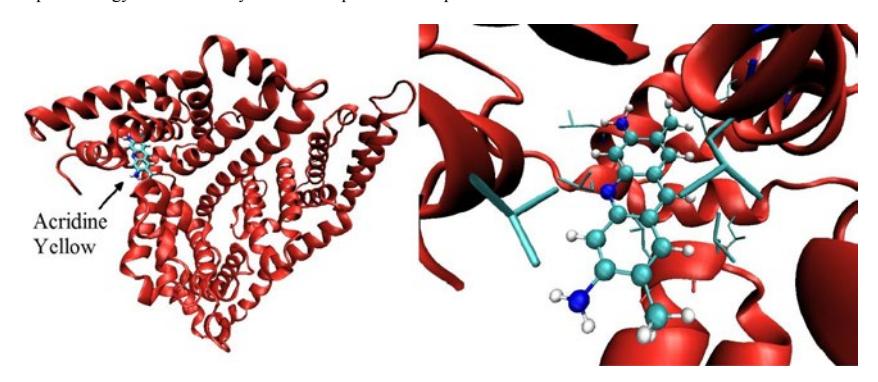
The fatty acid binding site in sub-domain IA of human serum albumin was chosen due to a high number of hydrophobic species present in the vicinity compared to the previously analysed binding sites [3]. Out of fourteen possible docking configurations found in this site, two, with most hydrogen bonds formed between acridine yellow and human serum albumin, were selected for the molecular dynamics calculations. The position of acridine yellow in the human serum albumin is presented in Fig. 1. Molecular dynamics simulations in the protein environment were also composed of extensive equilibration and production runs which lasted 3 ns and 2 ns respectively.
Hundred configurations from the last part of molecular dynamics simulations were selected for the quantum mechanical calculations and accordingly hundred excitation energies were calculated using QM/MM techniques. These calculations were run using "Dalton" program [4]. The density functional theory based calculations were run with CAMB3LYP functional and bases set 6-31+G* and aug-cc-pVDZ for calculations in water and bases set 6-31+G* for calculations in protein environment. The calculated excitation energies were summed up using a Gaussian contour and the absorption energy shift was analysed and compared with experimental results.
After comparing the experimental results with the results obtained from quantum mechanics – molecular dynamics calculations during this and previous work, it was seen, that the absorption energy shift was slightly higher than previously calculated in different binding sites. The values of absorption energy shifts for the two orientations were 0,15 eV and 0,19 eV. However, the shift is too small compared to the experimental 0,3 eV shift. Thus, from these results it cannot be stated, that the fatty acid binding site in sub-domain IA of human serum albumin is the one, that acridine yellow binds to. Further analysis must be made in order to certify this result.