
The detection of individual molecules has been applied in many areas of science – from molecular biology to quantum optics. The experimental ways of tracking the ultrafast dynamics in the molecules in time scale have emerged recently [1]. These methods have given the best opportunity yet to fully understand the processes of photosynthesis. New experimental data needs theoretical models which can explain the results of ultrafast spectroscopy experiments on single photosynthetic complex.
We have chosen to analyze the photosynthetic complex LH2 as it has very simple structure and its physical properties are well-known. Photosynthetic antenna is cylindrical, characterized by $C_9$ symmetry. Two rings can be seen in the structure of LH2 – the upper B850 ring and lower B800. B800 ring consist of 9 bacteriochlorophyll molecules and B850 is compounded of eighteen BChl molecules [2]. Recently the nature of electronic excitations created by photon absorption in the cyclic B850 aggregates of LH2 antenna complexes of photosynthetic bacteria has been thoroughly studied over a broad temperature range using absorption, fluorescence, fluorescence anisotropy spectra [3] as well as 2D coherent spectroscopy [4]. The steady state spectroscopic data is reproduced by consistent self-trapped exciton model which was developed on the basis of variational approach.
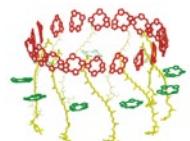
In this work, we extend the self-trapped exciton model into transient time domain. In order to follow the exciton evolution during its lifetime we assume that the slow protein dynamics at pigment sites triggered by fast exciton subsystem are governed by the Langevin equation:
$$\begin{cases}M\ddot{u}_{n} + M\lambda\dot{u}_{n} + M\omega_{0}^{2}u_{n} = \chi|\phi_{n}|^{2} + \eta_{n} \\ (e_{n} + \chi u_{n})\phi_{n} + \sum_{p\neq n} J_{np}\phi_{p} = E\phi_{n}\end{cases}\tag{1}$$Where, M is the molecular mass, $u_n$ represents the elastic degree of freedom at site n, $\omega_0$ is the frequency of the oscillations, $\chi$ – exciton-deformation coupling parameter. In order to describe the interaction of the deformation with the thermal reservoir at the temperature T, damping $\lambda$ and noise $\eta_n$ are included. $E_n$ is the molecular site energy and $J_{np}$ – is the excitonic interaction energy. $\phi_n$ is wave function's n-th element in the vector representation [5].
The simulations have showed very rich exciton behaviour which strongly depends on the environmental parameters and noise. Particularly, we have observed the rapid fluctuations of exciton size as well as its localization on different segments of the aggregate. The analysis of the corresponding simulated transient fluorescence spectra shows that they share many features observed in the experiments of single complex spectroscopy.