The modification of the surface of graphite felt (GF) filaments with chemically or electrochemically active spaces (functional groups, nanoparticles, coatings etc.) commonly is carried out by means of so-called wet-processes in aqueous solutions. Surface pretreatment of GF filaments is one of the key procedures before modification. Since GF is highly hydrophobic material, the first stage of pretreatment is increasing of its hydrophility or wettability. Wetting properties of any solid substance are related to equilibrium of interfacial forces at the boundary of surfaces of three phases, i.e. solid, liquid and vapor. A quantitative parameter of the wettability is a contact angle measured between surfaces of interacting solid and liquid. The chemical nature and surface roughness of the solid and surface tension of the liquid play a very important role [1-3].
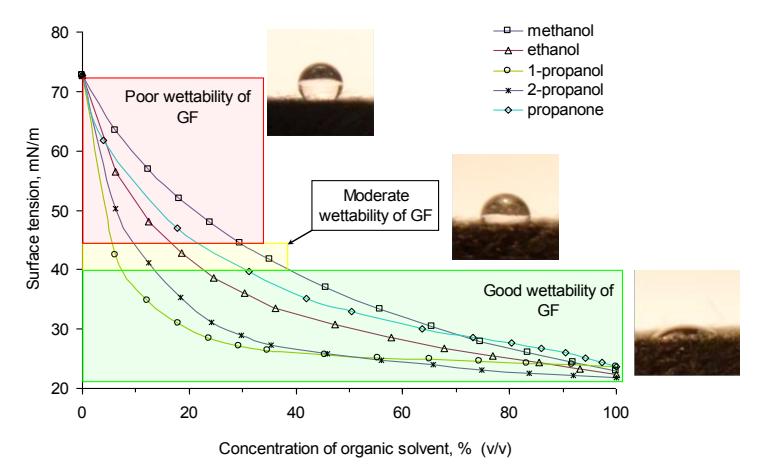
The aim of this investigation was to evaluate the GF wetting with some organic solvent-water mixtures of different concentrations by measuring contact angle. Organic solvents with low values of surface tension and mixable well with water: methanol CH3OH, ethanol C2H5OH, 1-propanol (n-propanol, C3H7OH), 2-propanol (isopropanol, (CH3)2CHOH) and propanone (acetone, (CH3)2CO) were chosen the measurement of contact angle between flat surface of GF sample and above mentioned pure organic solvents was complicated since droplets of these solvents penetrated immediately into GF matrix. In certain cases contact angles lower than 30° were observed for few seconds until penetration into GF. On the other hand, this demonstrates directly a very good wettability of GF sample with these solvents. As a result of series experiments, minimum sufficient concentration of these solvents in aqueous mixtures, which show good enough and fast wettability of GF filaments matrix, were determined. Most probably, better wettability is due to almost twice lower surface tension values of the mixtures than those of pure water [4, 5]. The aqueous solutions with lower concentration of these solvents demonstrate poor wetting of GF filaments (contact angle >90°) and droplets of such solutions as well as the ones of pure water remained on the surface of GF sample for a very long time (up to few hours) (Fig. 1).