
With increasing focus in energy efficiency solutions for the benefit of the environment, solar power is becoming one of the main renewable energy sources. Expected growth in this field to reduce costs and increase efficiency on currently used solar cells requires new technological developments.
Novel possibilities for promising improvements of Si-based solar cells are based on the three-dimensional (3D) solar cell concept with the light trapping on the surface [1]. This concept is promising for the solar cell efficiency increase due to high p-n junction surface. The main objective of this study was to fabricate a porous silicon matrix for 3D solar cell with controllable pore diameter coincident with the visible light wavelength for solar cells and by reduction in this way of reflectance.
The Por-Si was made using standard electrochemical etching setup [2] on a p-type silicon substrate. The electrochemical etching was performed in different ratio of HF and dymethylformamide (DMF) (0.1-1) with the current density 10-40 mA/cm2 for 1-15 min in the dark. The influence of the intensity of the cell vibration on etching process of por-Si was investigated (Fig. 1). Optical and surface analysis methods were used for the examination of formed porous 3D matrix structural parameters.
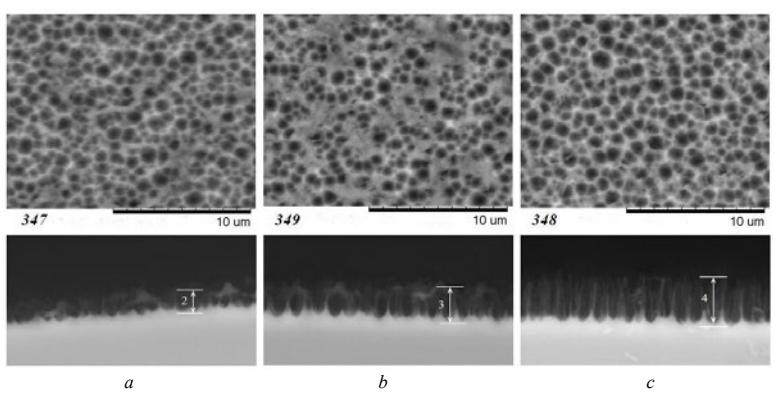
In the structure, the pores were perpendicular to the surface, the diameter was 500-850 nm and depth was 0.5-4 μm. Regardless of the intensity of the cell vibration, the reflection coefficient was evenly spread throughout the visible light wavelength range and its value decreased depending on the depth of the pores. The minimum reflection coefficient of the 3D por-Si structure with pore depth ~ 4 μm and the pore diameter (750 - 850) nm reaches ~ 8.2% (reflectance reduced by 75% compared to bulk Si).