
Recently, silver nanoparticles (AgNPs) have attracted much attention because of their unique size and shape dependent optical [1], electrical and magnetic properties. Possible manipulations of these properties lead to various applications of these nanoparticles in optoelectronics, biosensing, catalysis, enhanced optical spectroscopies [2], as antimicrobials [3] and other [4]. For practical use it is crucial to understand the influence of size, shape, aggregation, stability [5] and other features of nanoparticles to their optical properties.
In this work, influence of spherical and triangular AgNPs on optical properties of highly fluorescent organic dyes (rhodamine 6G (R6G), sulforhodamine 640 (SR640)) was investigated. Spherical AgNPs were prepared using few wet-chemistry techniques: reduction of silver salt (AgNO3 + NaBH4 → Ag + H2 + B2H6 + NaNO3) – AgNPs with absorption maximum at 390 nm, Turkevich method (4Ag+ + Na3C6H5O7 + 2H2O → 4Ag0 + C6H5O7H3 + 3Na+ + H+ + O2) - AgNPs with absorption maximum at 420 nm. Three different in size triangular AgNPs (absorption maxima at 630, 665 and 705 nm) were synthesized using different concentrations of AgNO3, NaBH4, Na3C6H5O7 and H2O2.
Thin films were made on glass, which was silanized using APTES (3-aminopropyltriethoxysilane) solution in acetone. Solutions and thin films of nanoparticles and organic dyes were investigated by using SEM imaging (Fig. 1), steady-state and ultrafast time-resolved absorption and fluorescence spectroscopy.
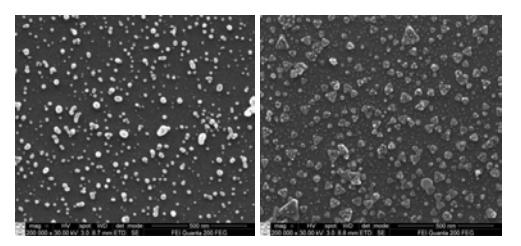
Steady-state absorption spectra showed that R6G causes aggregation in AgNPs solution because Cl ion, which disrupts the borohydride (B2H6) protective layer around nanoparticles, when they are synthesized from reduction of silver salt. On the contrary, SR640 stabilizes this AgNPs solution. Turkevich method gives us bigger AgNPs, which are stabilized by a protective layer of sodium citrate (Na3C6H5O7) and the advantage is that this reductant is non-toxic and more environmentally friendly than other methods [6]. Also it was noticed that PVP (polyvinylpyrrolidone), used for stabilization of AgNPs, cause small (~5 nm) red shift for all nanoparticles.
Analysis of ultrafast time-resolved spectroscopy measurements of thin films revealed influence of localized surface plasmon resonance of AgNPs to R6G and SR640 exited state relaxation dynamics.