
Aerosols contribute to atmospheric pollution and affect human health. Additional scattering and absorption of light caused by aerosols has cooling effects on climate. Aerosol particles act as seeds for cloud droplets influencing the albedo of a cloud in addition to affecting its ability to produce precipitation.
Since March 2013 a Cimel sunphotometer is running at Peterhof (Russia). Two years of aerosol measurements have been analyzed. Sun photometer was used to measure the columnar aerosol optical depth (AOD) at the wavelengths of 340, 380, 439, 500, 675, 869, 937, 1019 and 1638 nm.
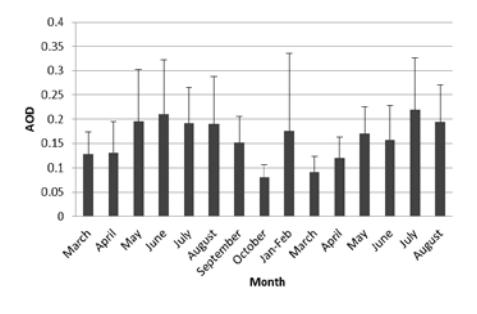
Figure 2 shows the monthly mean AOD at 500 nm from March 2013 to August 2014. The mean AOD varies on a monthly basis reaching minimum value in October (0.081 $\pm$0.026) and March (0.092$\pm$0.031) indicating that the atmosphere at that period was relatively clean. The lower mean AOD in autumn, which is the rainiest season of all, may be due to wash-out by rains. Growth of AOD in winter season may be associated with heating. Biomass burning, anthropogenic aerosols during winter (January, February) enhanced the AOD twice in comparison with October. However, due to the lack of sunny days in winter, data is less accurate. Generally speaking, the AOD values were smaller in fall and the biggest in summer.
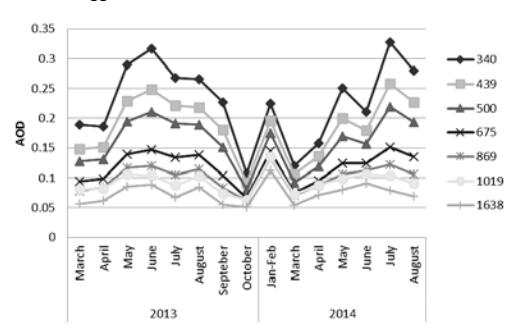
Diurnal variability of AOD is important for various applications, including satellite aerosol data validation, radiative forcing computations, studies of aerosol interaction with humidity and clouds, and public health [2]. AOD increases by 10-40% during daytime at most urban sites [2]. This trend is observed in Peterhof too. AOD increases in the morning, reaching the maximum value and then decreased. In 2013 in spring, summer and autumn maximum values are reached approximately from 12:00 to 16:00 (GMT+3). We observed that in 2014 AOD maximum value distribution during daytime was seasonally dependent. In winter AOD reached the maximum value at 15:00 and in spring at 12:00.
We correlated the optical depths for different wavelengths in Peterhof and nearby stations: Kuopio (Finland), Hyytiala (Finland), Helsinki (Finland), Helsinki Lighthouse (Finland) and Toravere (Estonia). In 2013 Peterhof station data correlated best with the data from Toravere station (0,64-0,68) and a similar trend was observed in 2014 with Helsinki station (0,64-0,68). Values of AOD in Peterhof and Toravere are considerably bigger than in other stations.