
Semiconductor quantum dots (QDs) owing to their unique atomic-like quantum confinement are particularly attractive both for fundamental research and applications in optoelectronic devices such as QD infrared photodetectors (QDIPs). Recently, an advanced QDIP structure was implemented by covering self-assembling InAs QDs with a strain-relieving InGaAs layer [1]. This dots-in-a-well (DWELL) design is based on intraband optical transitions between bound QD and quantum well (QW) states. This QDIP scheme offers additional possibility to alter optical response by adjusting QW width and composition. To optimize such structures it is necessary to know their optical properties and energy spectrum which can be examined by photoluminescence (PL) and photoreflectance (PR) techniques.
The samples studied were grown by molecular beam epitaxy and consist of InAs QDs with (sample L442) or without (sample L444) InGaAs cap layer, embedded in GaAs/AlAs QWs. Spectroscopic PR/PL data can be divided into two major sets of spectral features (Fig. 1 (a)). In the 0.9–1.25 eV energy range several broadened features are caused by QD ground-state (GS) and excited-state (ES) transitions (1–3 for L444 and 1–4 for L442). Further, in the 1.25–1.42 eV energy region features (4–7) for L444 sample are due to heavy- and light-hole interband transitions in WL, whereas sharp PR lines (5–7) for L442 structure are originated from InAs/InGaAs binary QW.
Experimental results revealed that a 5 nm-thick InGaAs cap layer significantly improves QD GS/ES signal intensity as it can be seen in Fig. 1 (a). Also, a shift of QD GS transition to lower energy by ~120 meV was observed [2].
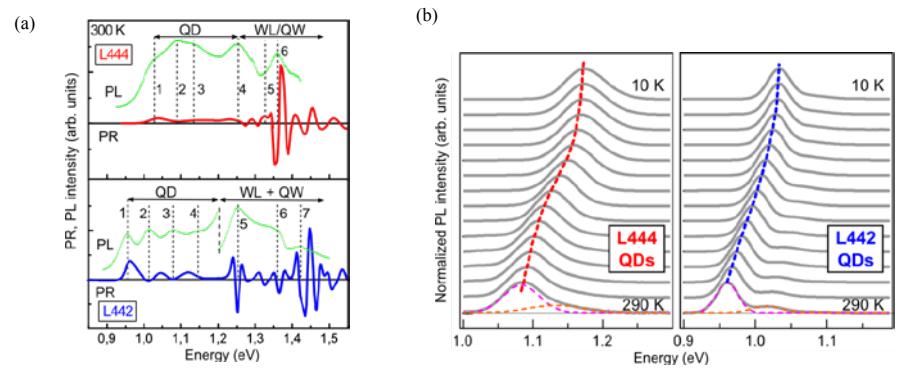
To get a deeper insight, investigation of the optical properties in DWELL nanostructures was supplemented by temperature-dependent PL spectroscopy. PL bands of InAs QDs in both samples shift toward lower energies with increase in temperature (Fig. 1 (b)). At elevated temperatures (≥150 K) high energy shoulder in QD PL band can be observed, indicating thermal population of excited states. It is obvious that PL full-width at half-maximum (FWHM) parameter is much wider for uncapped DWELL structure, owing to a less uniform size distribution of QDs. This leads to thermally activated carriers escaping and retrapping in QDs of different size, thus explaining anomalous reduction of FWHM parameter registered in uncapped sample PL spectra.
Thermal quenching of PL intensity from InAs QDs was analysed using Arrhenius expression. It was estimated that thermal quenching at intermediate temperatures (120–210 K) corresponds to the reduced carrier flow into QDs, whereas at high temperatures (210–290 K) it is probably caused by the excitons escaping from the QDs.
Temperature-dependent PR measurements were applied in 3–300K temperature range in order to investigate the variation of the lineshape and associated photomodulation mechanisms. In temperature region below 150 K lower PR intensities are attributed to the doping of InAs QDs. Whereas, a decrease of intensity at elevated temperatures is related to thermal activation of the carriers from InAs QDs to InAs/InGaAs QWs.