
The substances, electric and magnetic properties of which have a strong correlation, are promising for applications in microelectronics [1]. Solid solutions with cation substitution in the Mn1-xGdxSe system, having semiconducting properties, can be attributed to such substances. The purpose of this work is a synthesis of Mn1-xGdxSe solid solutions, studying the characteristics of their magnetic properties depending on the composition and temperature.
The compositions of $Mn_{1-x}Gd_xSe$ ($0 \le x \le 0.9$) were obtained by solid state reaction method from powders of based limit compounds.
The specific magnetization of received compounds is studied by ponderomotive method in the 77 - 900K temperature range in a magnetic field with induction B = 0.86 T [2, 3]. The temperature dependence of the specific magnetization of Mn1-xGdxSe solid solutions for compositions with x = 0.05 and x = 0.7 are shown in Fig. 1.
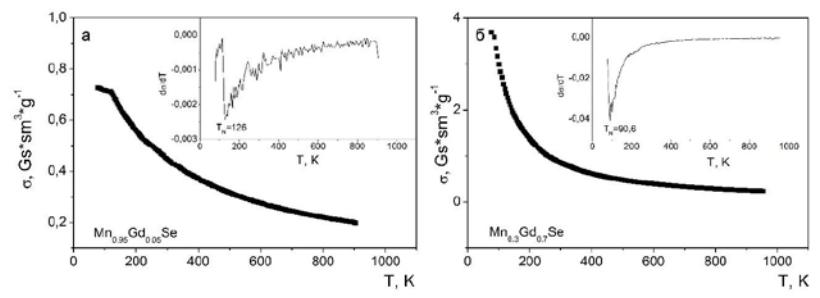
It is found that the heating of solid solutions up to a temperature of 900 K does not lead to irreversible changes in the magnitude of the magnetization. Dependences $ \sigma = f(T) $ in "heating-cooling" regime measurements are identical.
As a result of the research is found that the substitution of manganese by gadolinium in solid solutions of Mn1-xGdxSe system leads to an increase in the average magnetic moment. It is revealed a slight decrease in the phase transformation "magnetic order - magnetic disorder" temperature with increasing concentration x of gadolinium. This is most likely due to a disturbance of the exchange interactions with cationic substitution [4].