The electronic properties of graphene, a two-dimensional crystal of carbon atoms, are exceptionally novel. For instance, the low-energy quasiparticles in graphene behave as massless chiral Dirac fermions which have led to the experimental observation of many interesting effects similar to those predicted in the relativistic regime.
Graphene can be considered as the building block of many carbon allotropes. It is a two-dimensional crystal with hexagonal structure consisting of a bipartite lattice of two triangular sublattices. Each atom is tied to its three nearest neighbors via strong σ bonds that lie in the graphene plane with angles of 120°. The σ bond is a result of the sp2 hybridization of the 2s, 2px, and 2py orbitals for the three valence electrons. The fourth valence electron is in the 2pz orbital that is orthogonal to the graphene plane. A weak π bond is formed by the overlap of half-filled 2pz orbitals with other 2pz orbitals. The transport properties of graphene are determined by these delocalized π electrons. Also, the measured electron mobility of graphene is ultra-high and exceed 200000 cm2/Vs [1].
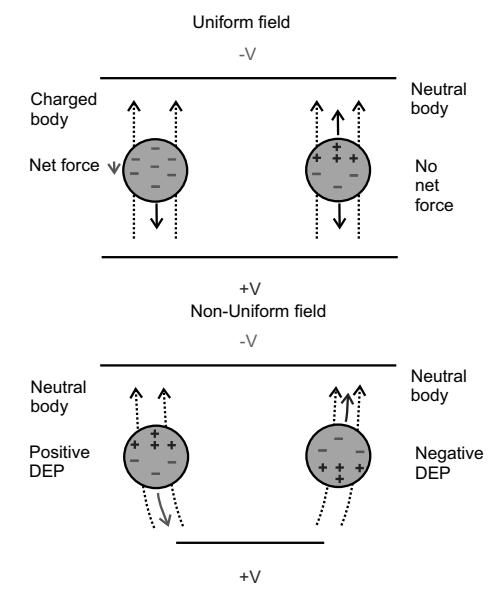
$$\mathbf{F}_{\text{DEP}} = (\mathbf{p} \cdot \nabla)\mathbf{E} \tag{1}$$At this work we represent up to few layers thickness graphene application to FET transistors and terahertz imaging. The process of dielectrophoresis (Fig. 1) allows site-selective deposition of few layers graphene. One of the ways to form graphene flakes at the certain place on the substrate is employing nonuniform electric field. This method (dielectrophoresis [2]) allows the selective deposition or directed movement of spherical and one-dimensional micro and nanoscale objects in nonuniform electric fields. This includes polymer particles, cells, DNA, nanowires and bundles or individual carbon nanotubes for physical properties characterization. The dielectrophoretic force Eq. (1) is exerted on an induced dipole moment p of a plarizable particle in a nonuniform electric field E, which is proportional to the electric field gradients.