
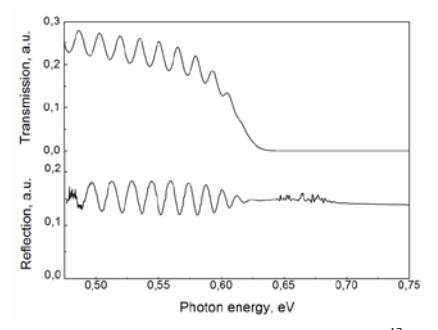
The InN compounds in comparison with other known AIN, GaN and InN nitride semiconductors with direct-gap energy structure are least studied [1,2].This is caused by the fact that growth of material with qualitative structure and electronic properties is difficult due to passivity of molecular nitrogen relative to metal indium and low temperature stability (~620 – 630° C) of InN compound. In the present study, we investigated the electronic structure of high-quality thin films of nanostructured InN, grown on sapphire substrates by molecular beam epitaxy method. Studies were carried out in a wide temperature range 4.2 – 300 K using various spectroscopic techniques: optical transmittance, reflectance, luminescence and registration of luminescence excitation spectra. According to the optical transmission and reflection measurements it was revealed that the films with the lowest concentration (n-type conductivity), $n_e \sim 3.6 \cdot 10^{17}$ and $5.4 \cdot 10^{17}$ cm3, for InN compounds, have band gap at room temperature equal to $E_g \sim 0.624$ eV and $E_g \sim 0.636$ eV, and at 4.2 K - $E_g \sim 0.675$ eV and $E_g \sim 0.679$ eV, respectively (Fig. 1).
For the first time in the near-band edge absorption region at cryogenic temperatures in the range of ~ 4.2 – 30 K the fine structure of the bands in photoluminescence spectra has been resolved. Luminescence bands were assigned to certain types of recombination centers formed during molecular beam epitaxial growth of InN thin films. In particular, it is shown that the appearance of two photoluminescence bands in the spectral range of 0.59 – 0.63 eV is related to the existence of two types of acceptor levels in the band gap of InN. The energy levels of the acceptors are determined and possible natures of defects related with these levels are discussed for InN nanostructured films.