
Direct laser writing based (DLW) true 3D lithography (also known as two-photon polymerization (2PP)) is a technique offering unmatched flexibility in creating arbitrary shape free-form structures of various cross-linkable materials [1-4]. During the last decade it has covered application fields of photonics, microoptics, microfluidics, and biomedicine. Currently it is being implemented as a high-end 3D printer ensuring nanoscale resolution and wide material spectrum ranging from metals to proteins. Despite that, several photo-physical and photo-chemical mechanisms are intensively discussed and sometimes contradictory (see references for details [1-3]). The majority of the efforts were targeted towards improving structuring spatial resolution and investigation of novel materials. Up to date exists only a single report [4] related to polarization's influence on DLW based photo-polymerization at nanoscale.
Thus, we present a systematic study on femtosecond laser light polarization's influence to polymerizable features. We chose SZ2080 (Si and Zr containing organic-inorganic hybrid) and PETA (pentaerythritol triacrylate) as photoresists sensitized with 1% w.t. Michlers ketone. Ti:Sapphire oscillator (800 nm, 80 MHz, 100 fs) and Yb:KGW amplified laser system (1030 nm, 1 - 200 kHz, 300 fs) were employed as irradiation sources, 100 μm/s sample translation velocity was kept constant. The chosen experimental parameters represent materials, setups and nanostructuring conditions commonly used in DLW nanolithography. By varying the polarization we aimed to distinguish its influence on photo-polymerized features namely: the fabrication window, the line width, height and aspect ratio. Typical test structure micrographs and spatial resolution dependence on irradiation polarization (in respect to sample translation direction) are shown in Fig. 1(a,b) and (c), respectively.
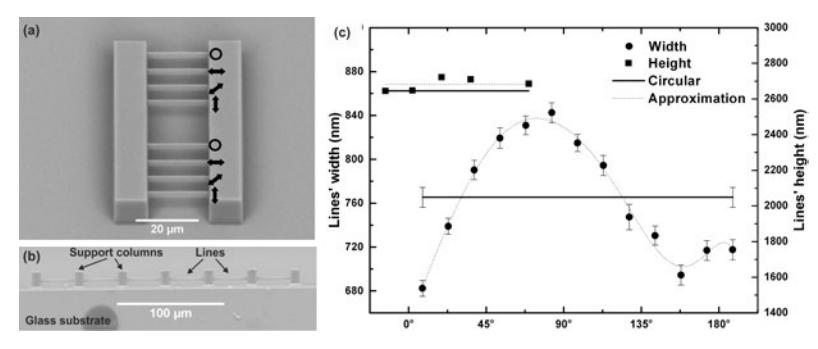
In brief, we report on investigation of fs pulsed-light polarization influence to the 3D polymer nanostructuring spatial resolution. We show that the orientation of electric field at the focus induces peculiarities significant for the final polymerized features. Physical mechanisms responsible for it are modeled and presented as well as compared to the ripple formation in metals and transparent dielectrics [5]. Practical issues regarding reaching the highest spatial resolution and optimization of reproducibility in DLW lithography are discussed.