
Magnesium dizinc is an intermetallic hexagonal crystalline compound ($a = 5.233 \text{ Å}$, $c = 8.566 \text{ Å}$ [1]) of the Laves phase. Primitive cell of Zn2Mg Laves phase contains twelve atoms, eight zinc atoms of which occupy two inequivalent sites, and four magnesium's atoms are in equivalent sites. The atomic composition of Zn2Mg and atoms local neighboring surrounding are similar to icosahedral fci-Zn60Mg30RE10 quasicrystals (RE = rare earth elements), and magnesium dizinc presents a convenient physical reference system for studies of both the atomic, and the electronic structure of the fci-ZnMgRE quasicrystals. From other side Zn2Mg structure is comparable to monocrystalline Zn, they both have hexagonal crystal symmetry and Zn2Mg consist of 67% zinc.
In this work we present spectroscopic ellipsometry (SE) study and qualitative analysis of interband optical transitions of Zn2Mg. Optical response from uniaxial metals depends on polarization of probing light. The main issue for reliable determination of both ordinary and extraordinary dielectric functions requires careful optical surface orientation and preparation. The (110) surface of Zn2Mg prepared using careful mechanical polishing and Ar+ sputtering in a UHV chamber. The optical response measured using a dual rotating compensator ellipsometer RC2 (J. A. Woollam Co., Inc.) in the 0.6 – 3.5 eV spectral range at various incidence and azimuthal angles in the intervals of 45–75° and 0–90°, respectively. At each angle the experimental ellipsometric parameters $\Psi$ and $\Delta$ were simultaneously recorded.
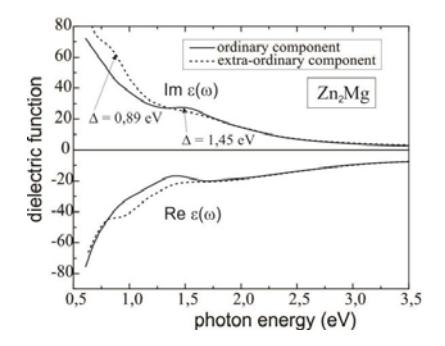
Experimental ellipsometric parameters were analyzed using the CompleteEASE (J. A. Woollam Co., Inc.) software, which can perform data analysis at all wavelengths. From experimental ellipsometric parameters were determined both ordinary and extra-ordinary components of Zn2Mg dielectric function, obtained spectra presented in Fig. 1. As see from figure, dielectric function have two optical features related to interband optical transitions. Interband optical transitions depends significantly on the polarization of the probing light beam. Optical transitions occur at pseudogaps, which opens at intersections of Bragg planes with Fermi surface. In hexagonal crystals pseudogaps opens at intersection with (002) and (110) Bragg planes. In Fig. 1 we clearly see two or one absorption peaks in the dielectric function spectrum, for E\text{||}C6 optical transitions occurs across A101 and A002 pseudogaps, for E\perp C6 occurs only across A101 pseudogap. Employing nearly free electron approximation and two band model we determined width of the pseudogaps values, which are A101=1.45 eV and A002=0.89 eV.
In order to reveal similarities we compared Zn2Mg optical conductivity with Zn and ZnMgY [3] optical conductivities. Results showed that electronic subsystem of zinc-based intermetallic compounds correlates between, comparing crystalline Zn with binary Zn2Mg crystal and the ternary icosahedral Zn62Mg29Y9.