
White light continuum (or supercontinuum) generation is a nonlinear optical phenomenon. During the generation the narrow spectrum of the initial laser pulse can spread many times and as a result a broad and smooth continuum is formed. The obtained white light can be applied in many different fields: telecommunication, medicine, material science. Many different nonlinear processes contribute to the broadening of the spectrum, therefore mathematical modeling of continuum generation is problematic. Most research on the properties of supercontinuum is carried out by experiments. Many publications on this topic can be found [1-3].
In this work, the properties of white light continuum, generated in sapphire, calcium fluoride (CaF2) and water were examined and evaluated. A small experimental setup was constructed for the measurements. Several laser sources were used: first and second harmonics of Coherent Libra laser (800 nm, 50 fs pulses with 1 kHz repetition rate) and also first and second harmonics of Light Conversion Pharos laser (1030 nm, approximately 300 fs laser pulses with 25 kHz repetition rate).
With each material and laser source the relative intensity and relative noise of every generated spectral component were measured. As an example of the measurement results, in Fig. 1 relative intensity of continua (left) generated with the used materials with the first harmonic of Coherent Libra laser are shown along with the relative noise (right).
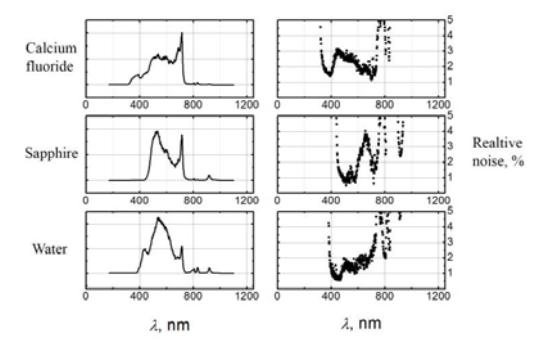
Comparing all the measurements, it can be said that calcium fluoride provides continuum spread furthest down the blue side of the spectrum. Using the second harmonic of the Libra laser, the obtained spectrum reached 260. This is due to the fact that calcium fluoride has the largest band gap of the all the used materials. In all of the measurements, the relative stability of the spectrum generated in calcium fluoride was less stable than in other materials, because the fluoride is quite sensitive to optical breakdown and the crystal had to be rotated in order not to damage it.
Using the 1030 nm pulses of the Pharos laser, one interesting result is that the pump wavelength is further from the center of the generated continuum. Thus, when trying to filter out the remains of the pump pulse from the continuum, less of the generated spectrum is lost. Using this laser the measured spectra were generally less stable, probably due to the laboratory conditions, which were not ideal. Also, due to the longer pulses and higher repetition rate, continuum was not obtained in water and calcium fluoride. In water due to the fact that the point where pulse would self-focus would begin to boil not long after the start of the exposure to the laser light and in calcium fluoride due to the increased risk of damaging the crystal.
The knowledge of the spectra gained in these materials using mentioned laser sources can be used in material science, specifically pump-probe experiments, where supercontinuum is used to measure absorption kinetics of various materials.