
The aim of this paper was to investigate quasi-two-dimensional structures based on TiS2 and TiSe2. Structures were modified by injection of monovacancies and its clusters. It has been studied how the different configuration of the vacancies lead to local structural deformation that were shown on STM pictures [1].
Layered materials of titanium disulfide and diselenide (TiX2, where X = S, Se) are typical representatives of quasi two-dimensional structures (2D) of 3d — 5d dichalcogenides of transition metals. Due to it layered structure and strong anisotropy of interatomic bonds in TiX2 it is possible to to create various intercalated and nanostuctured systems. Electronic properties in such systems can depend on the presence of different atomic defects [2].
The super-cell was built for the simulation of the described structures consisted of 6x4 unit cells. 8 main structural defects were investigated: points defects, cluster of the defects, and Frenkel defects (Fig. 1).
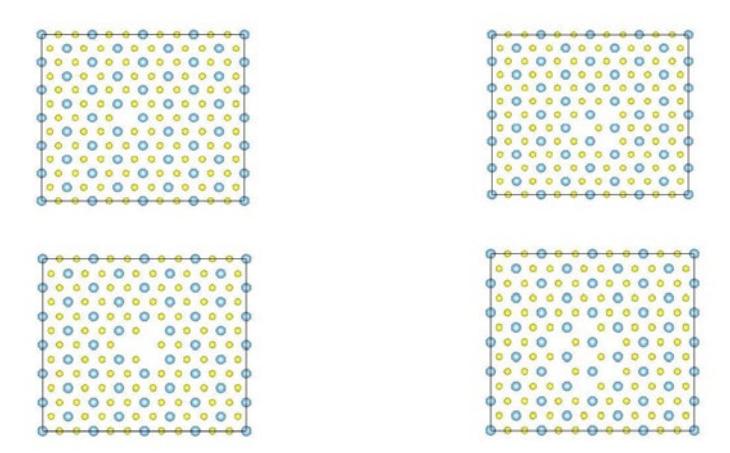
Analyzing the calculation data of the investigated structures of TiX2 the results of vacancies stability, densities of electron states, and band diagrams were calculated. As a result of conducted analysis the values of band gab were obtained. Quasi-two-dimensional structures of 1T-TiX2 with prismatic coordination of Ti atoms exhibits semiconductor properties with band gap values ranges from 0,12 to 0,15 eV. Further investigation in this area will allow to investigate a deeper level of understanding and explaining of the electronic properties patterns of nanostructured materials.